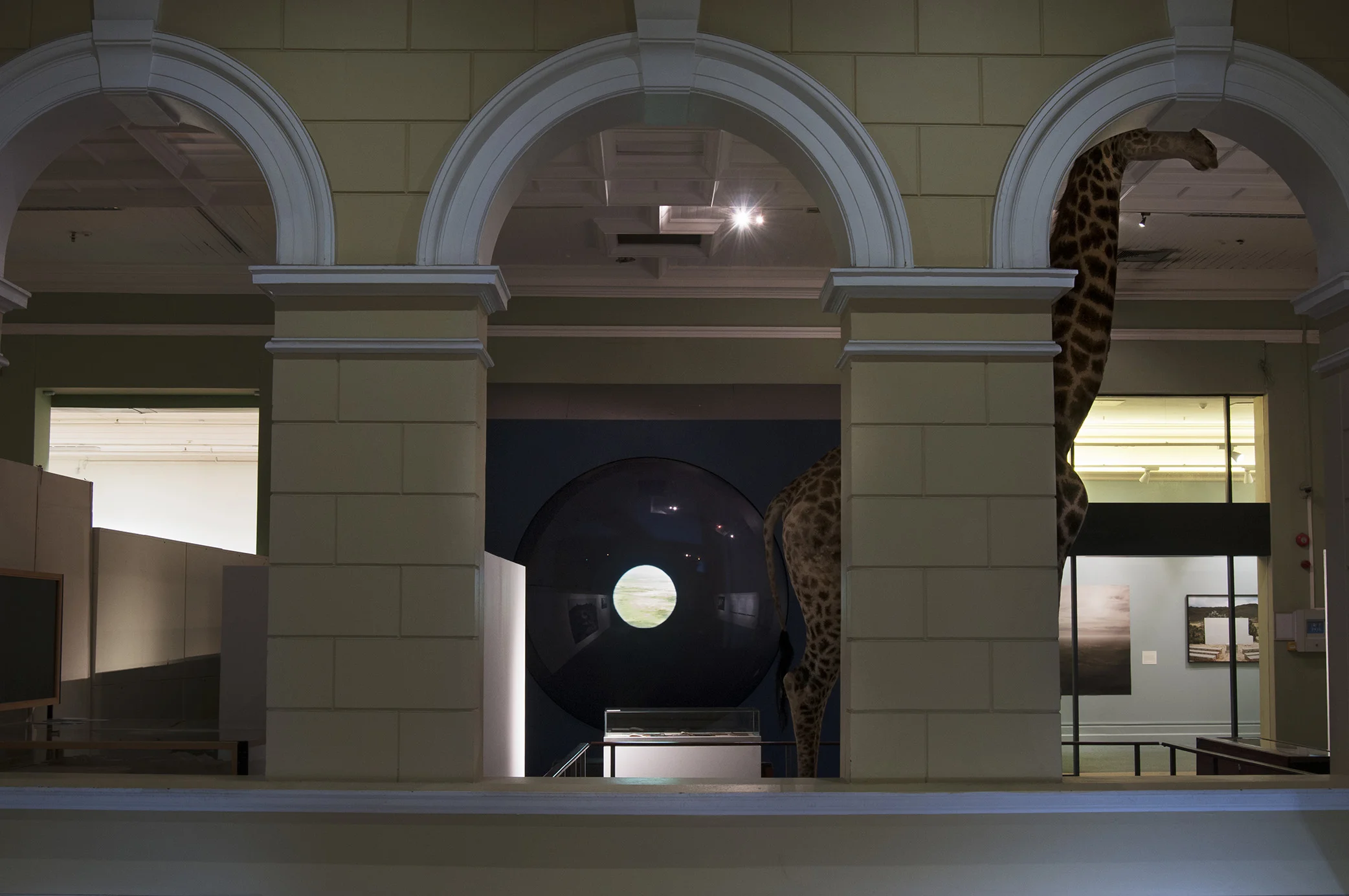
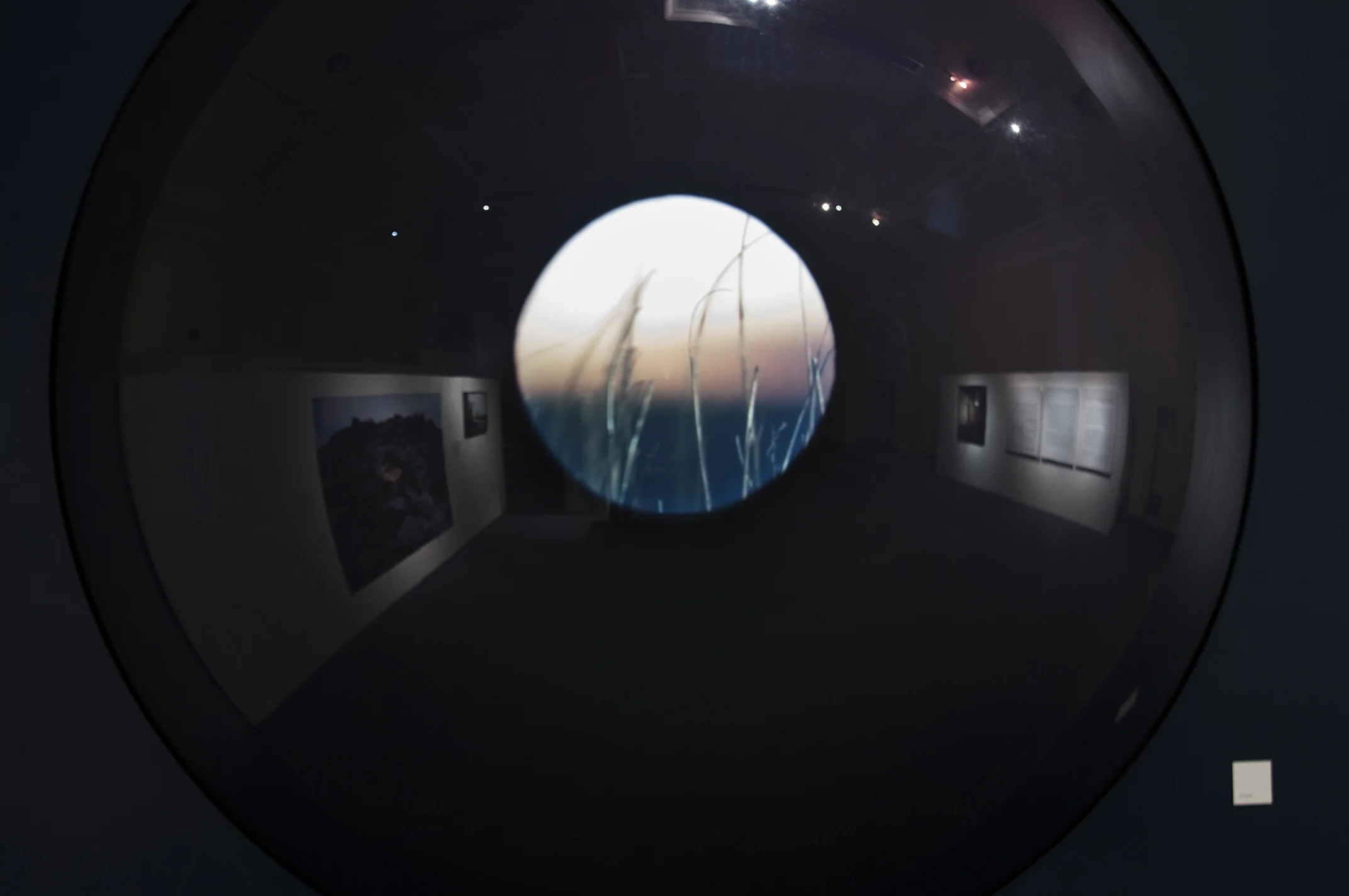
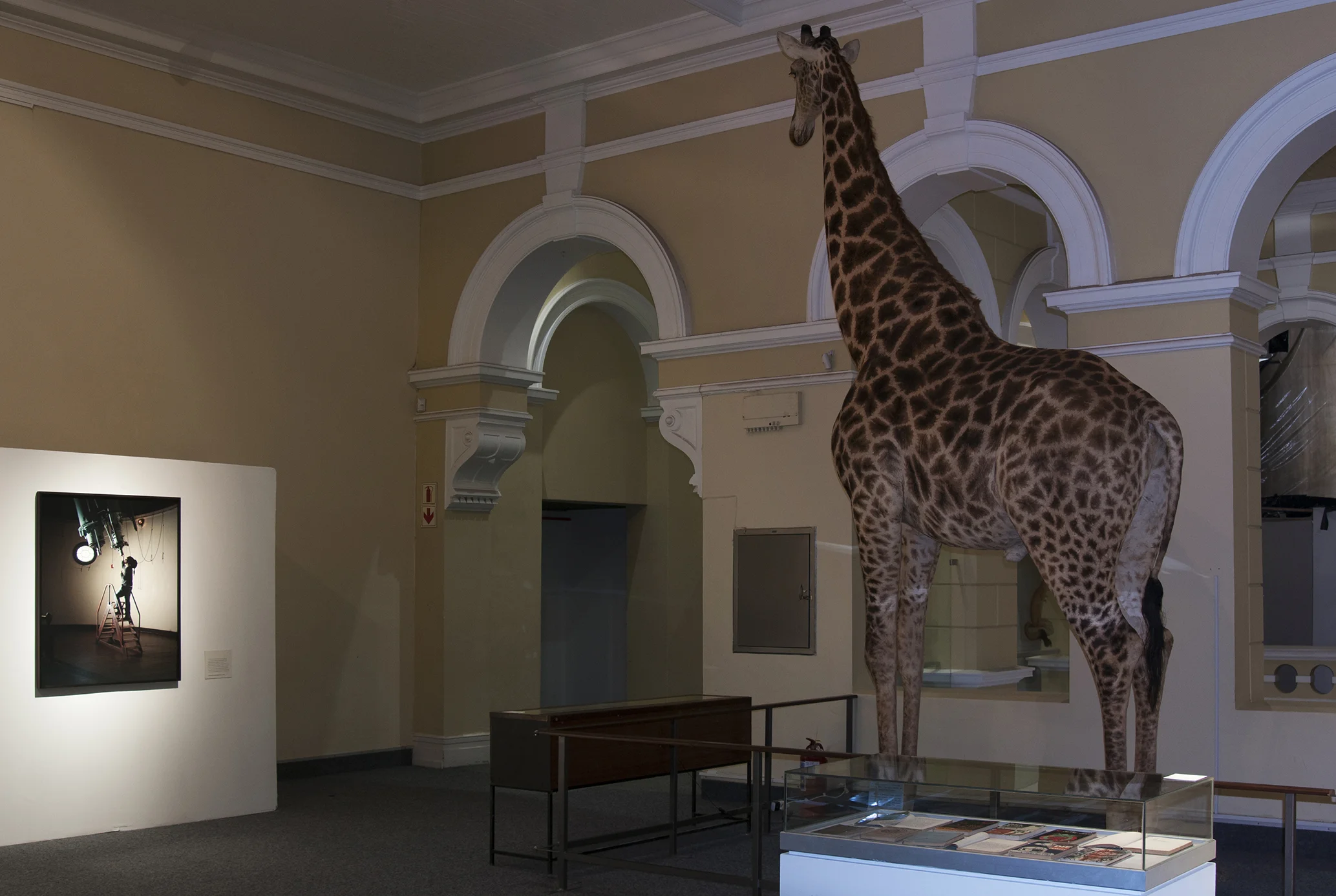
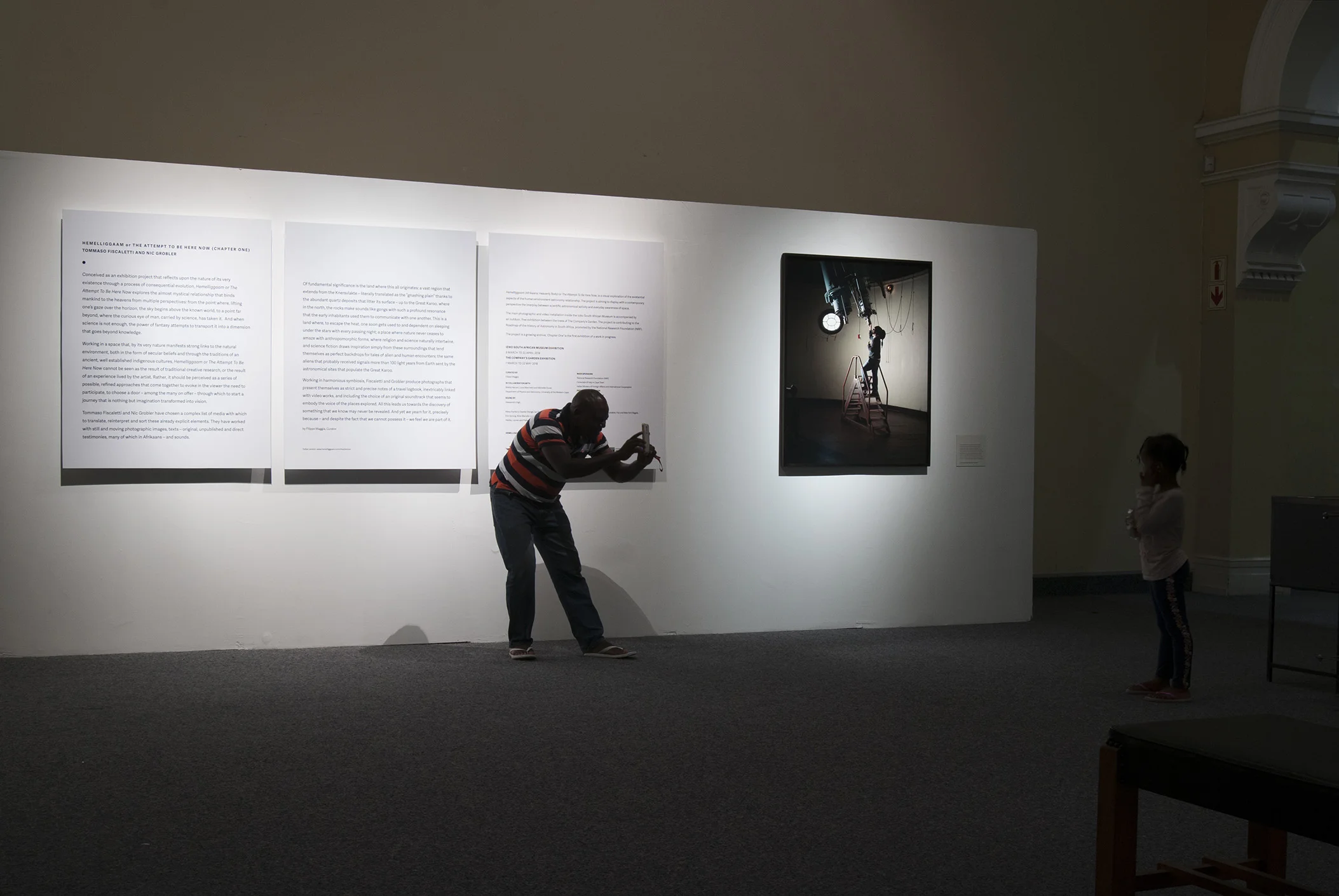
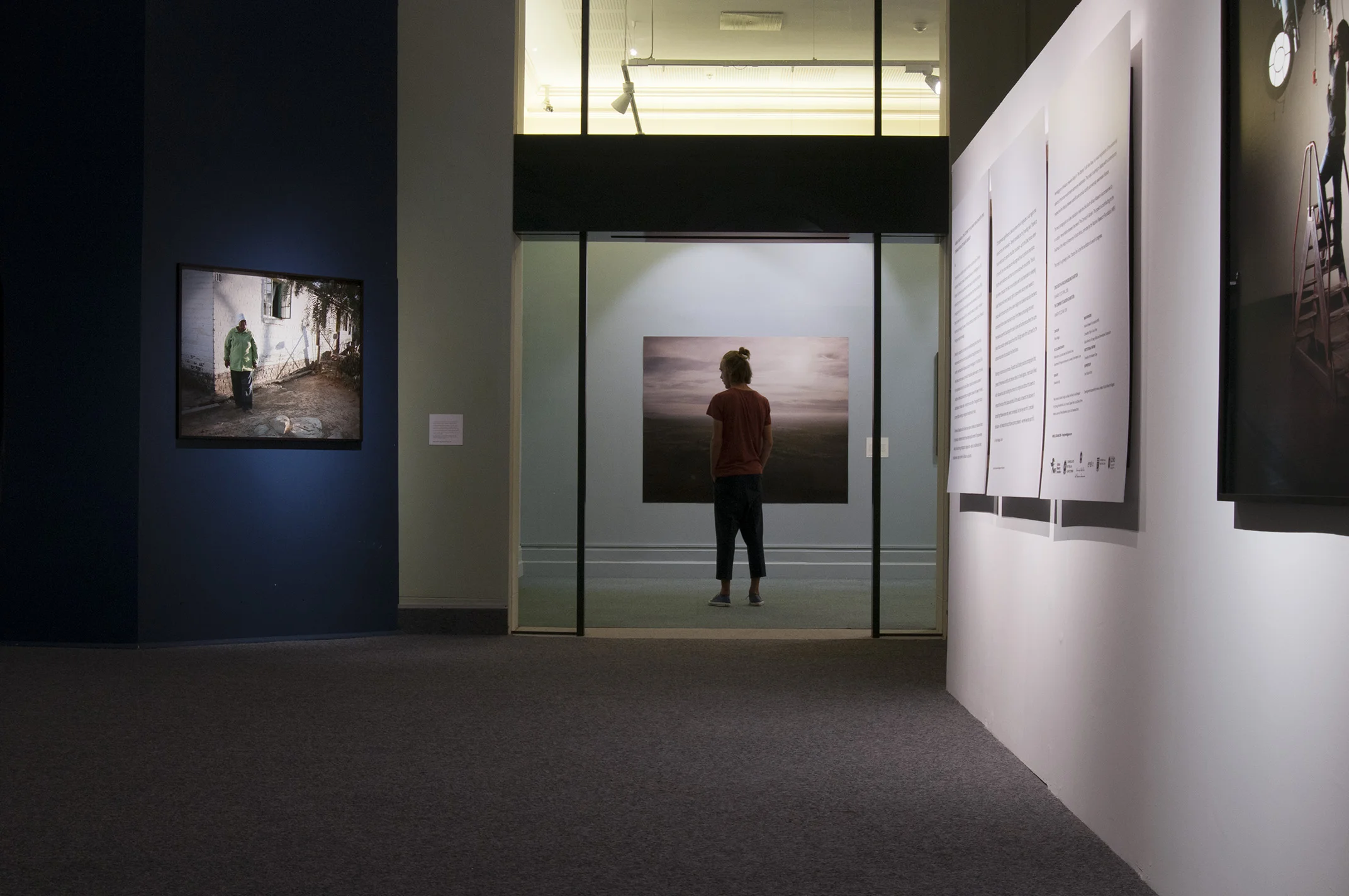
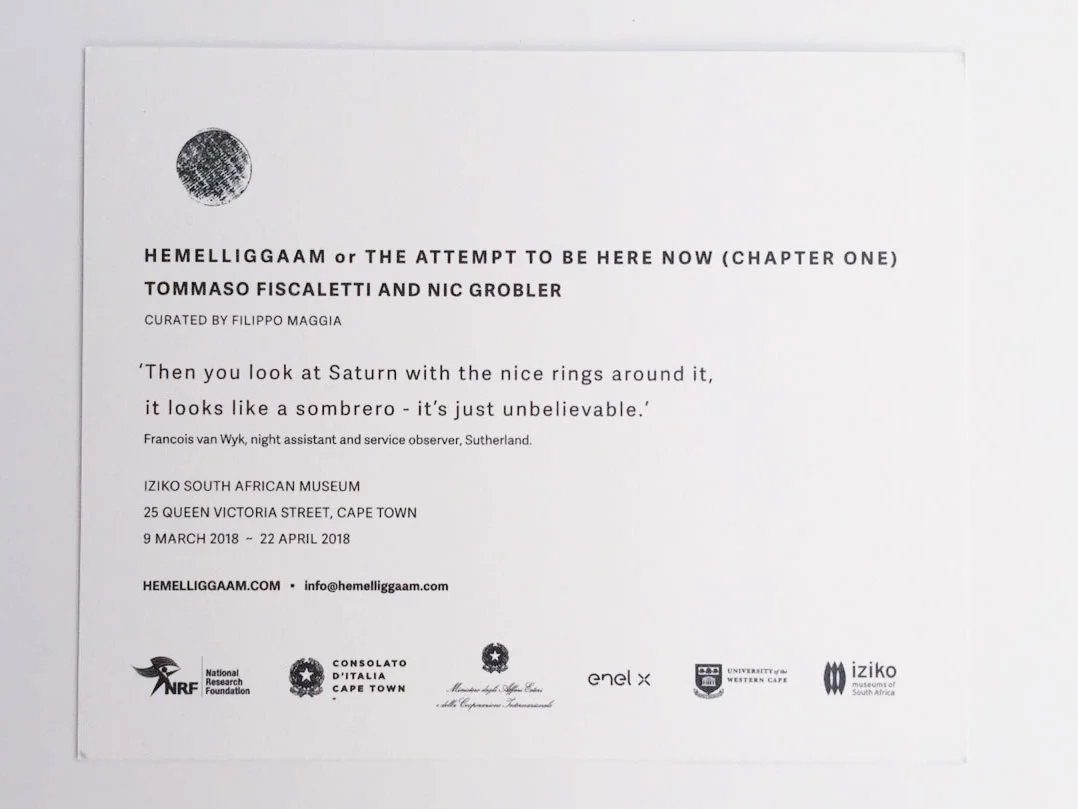
HEMELLIGGAAM or THE ATTEMPT TO BE HERE NOW (CHAPTER ONE)
TOMMASO FISCALETTI and NIC GROBLER
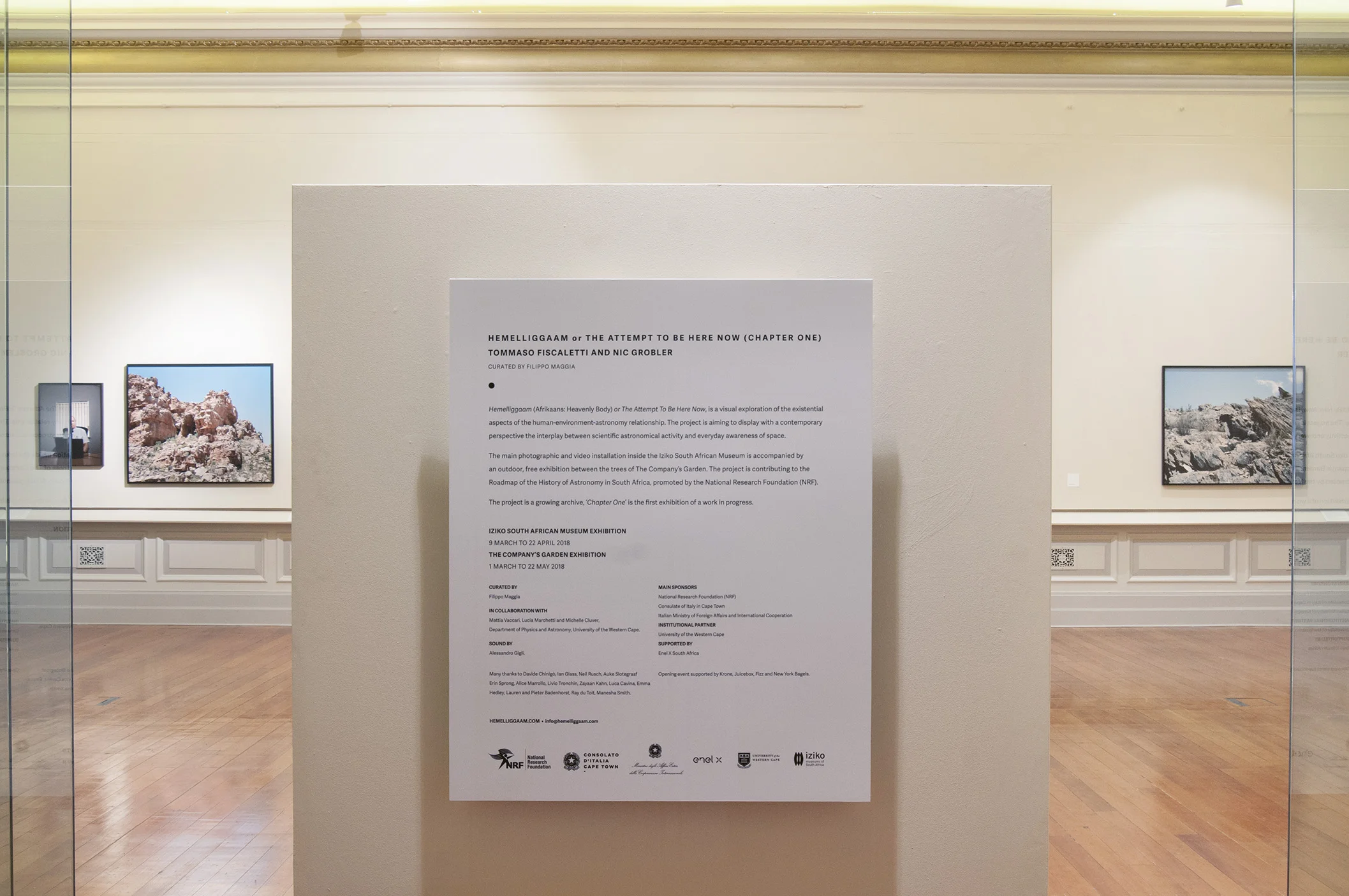
CURATED BY FILIPPO MAGGIA
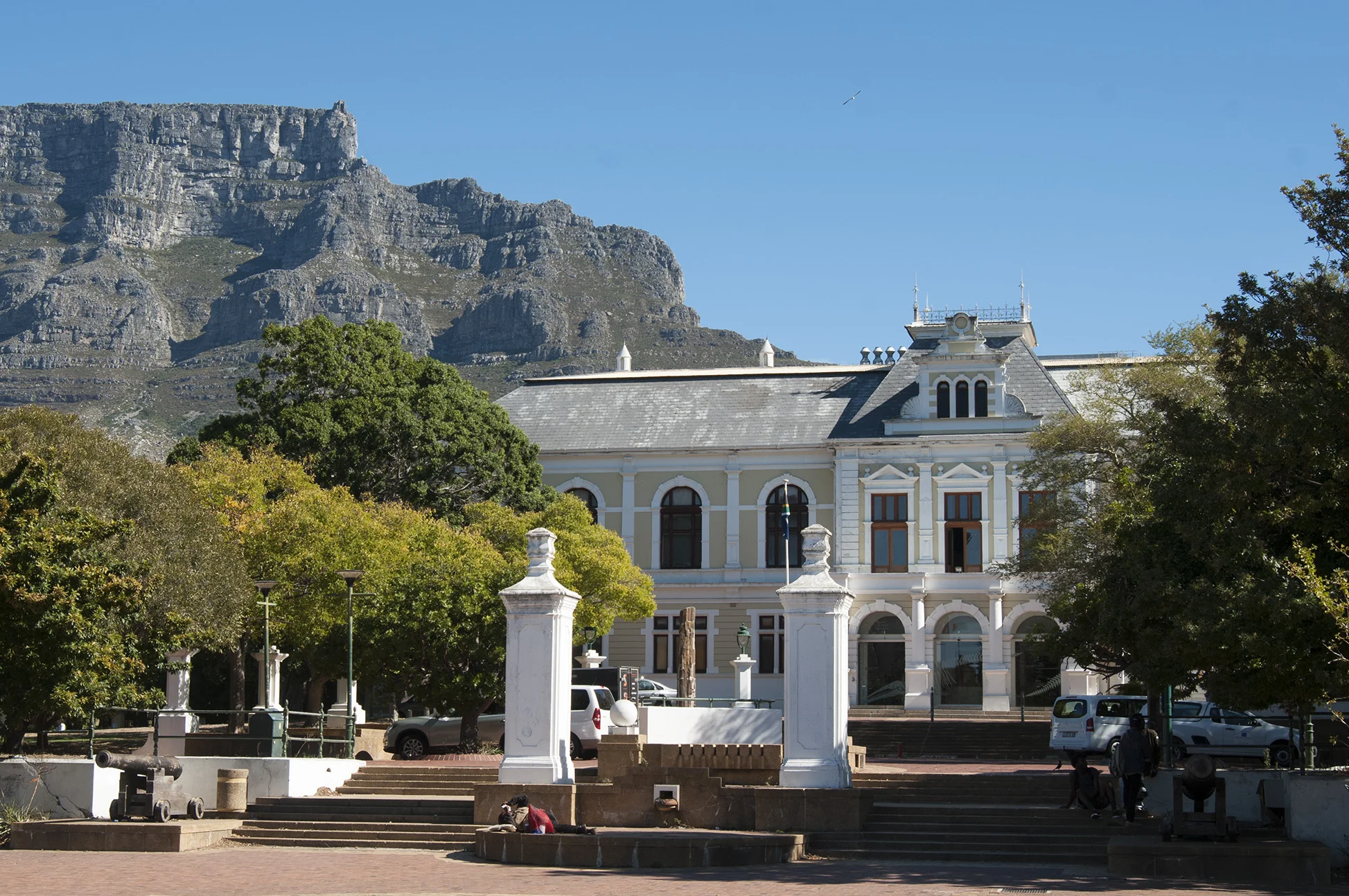
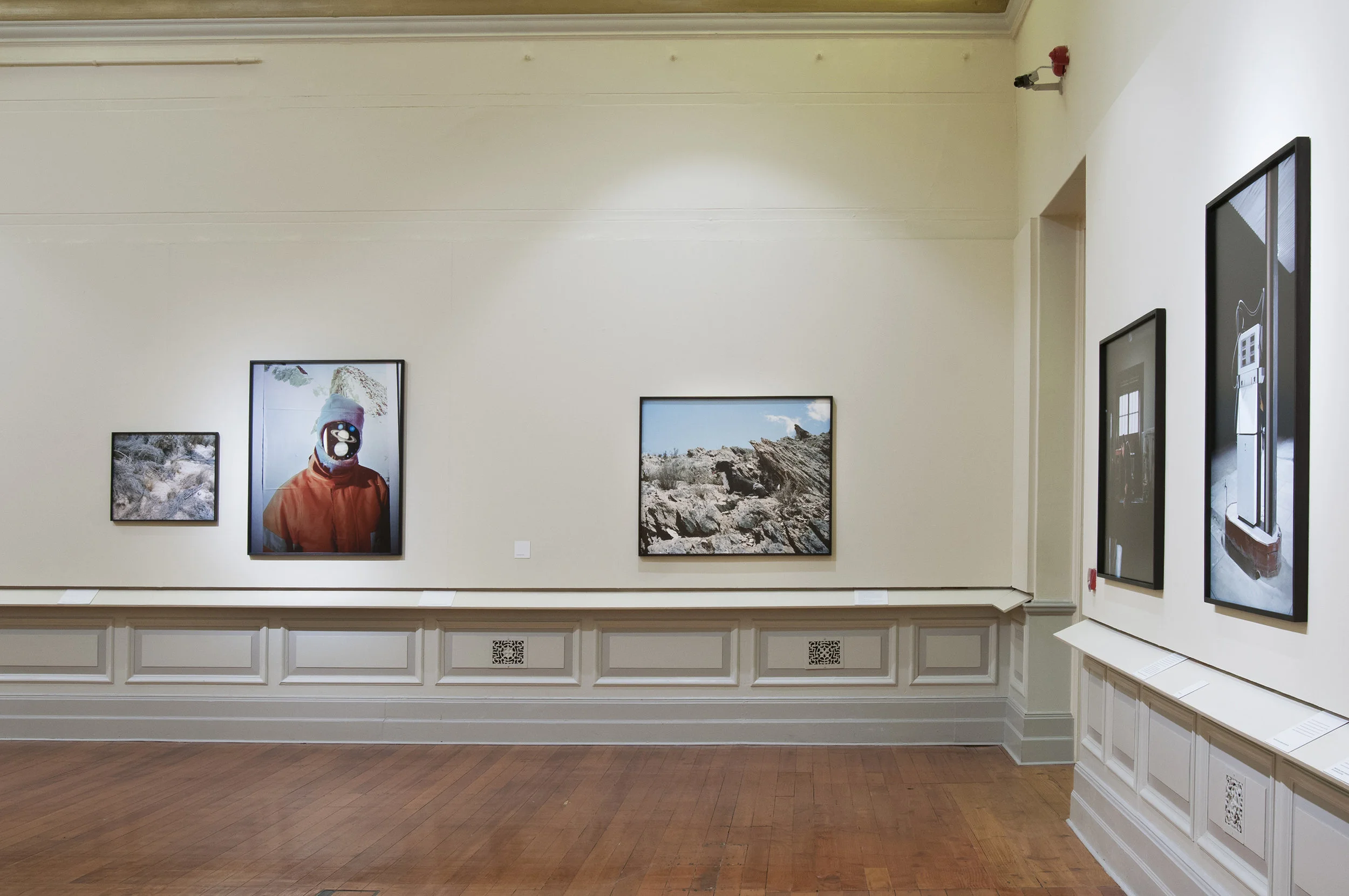
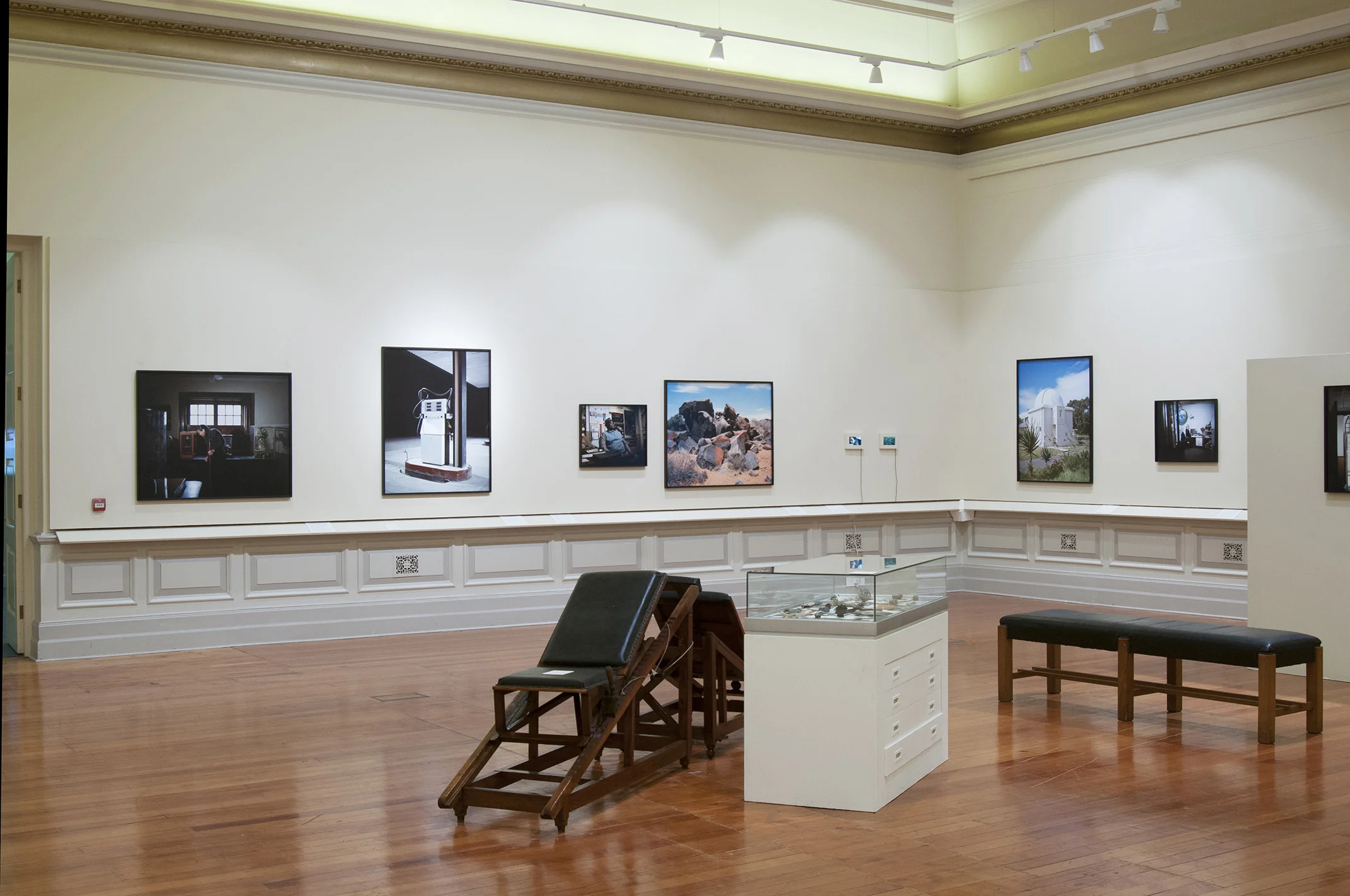
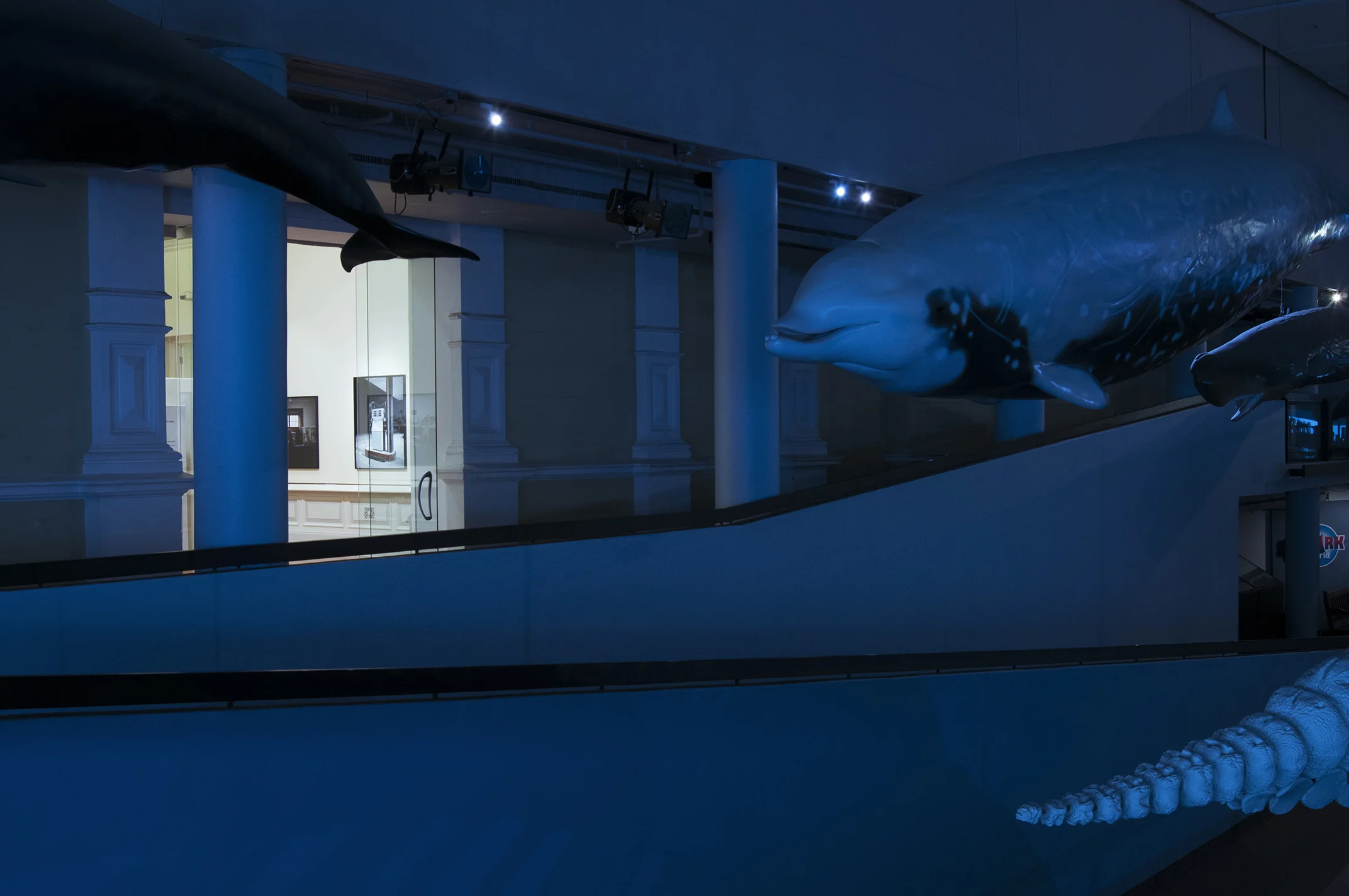
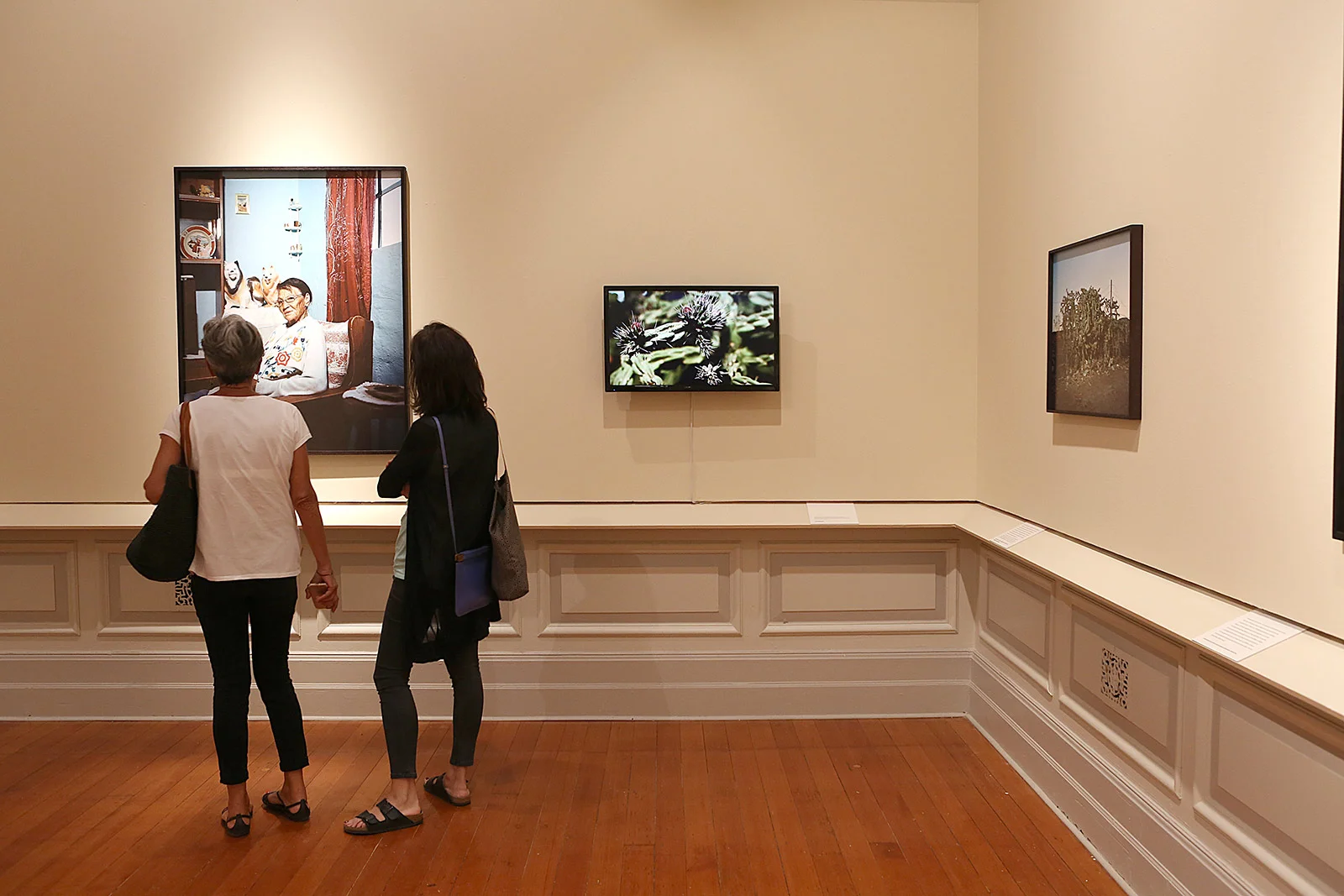
IZIKO SOUTH AFRICAN MUSEUM, CAPE TOWN, 8 MARCH - 22 APRIL 2018
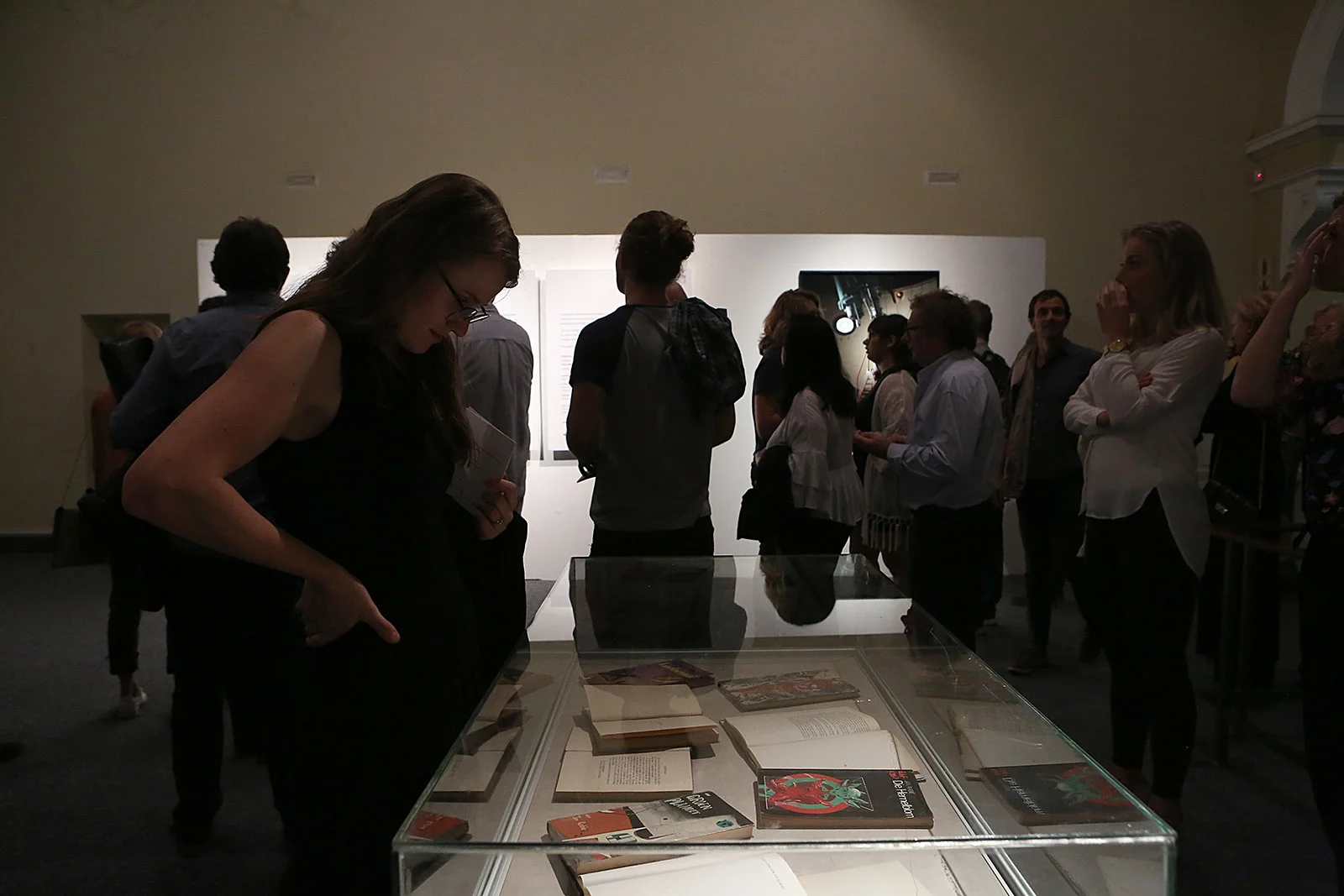
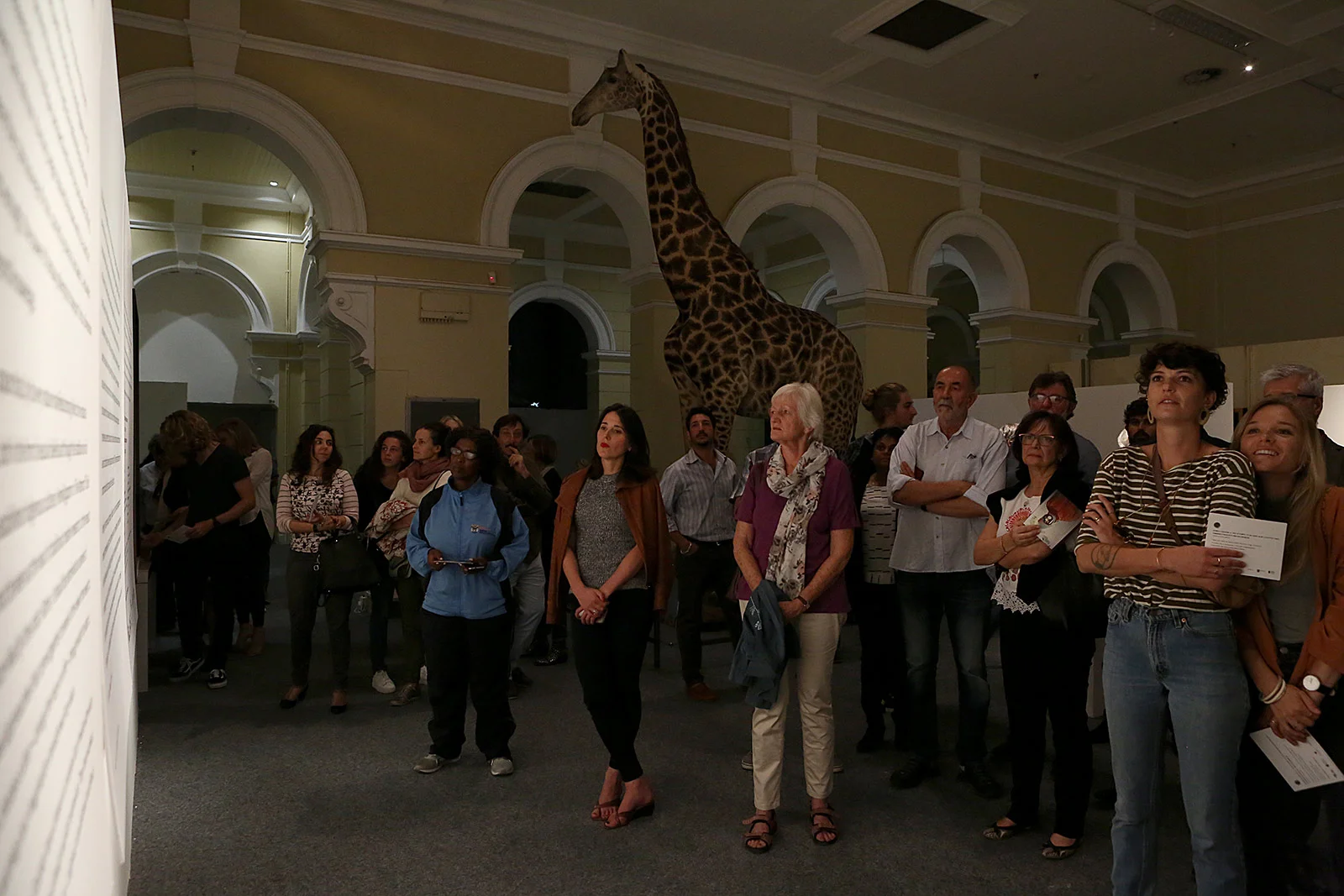
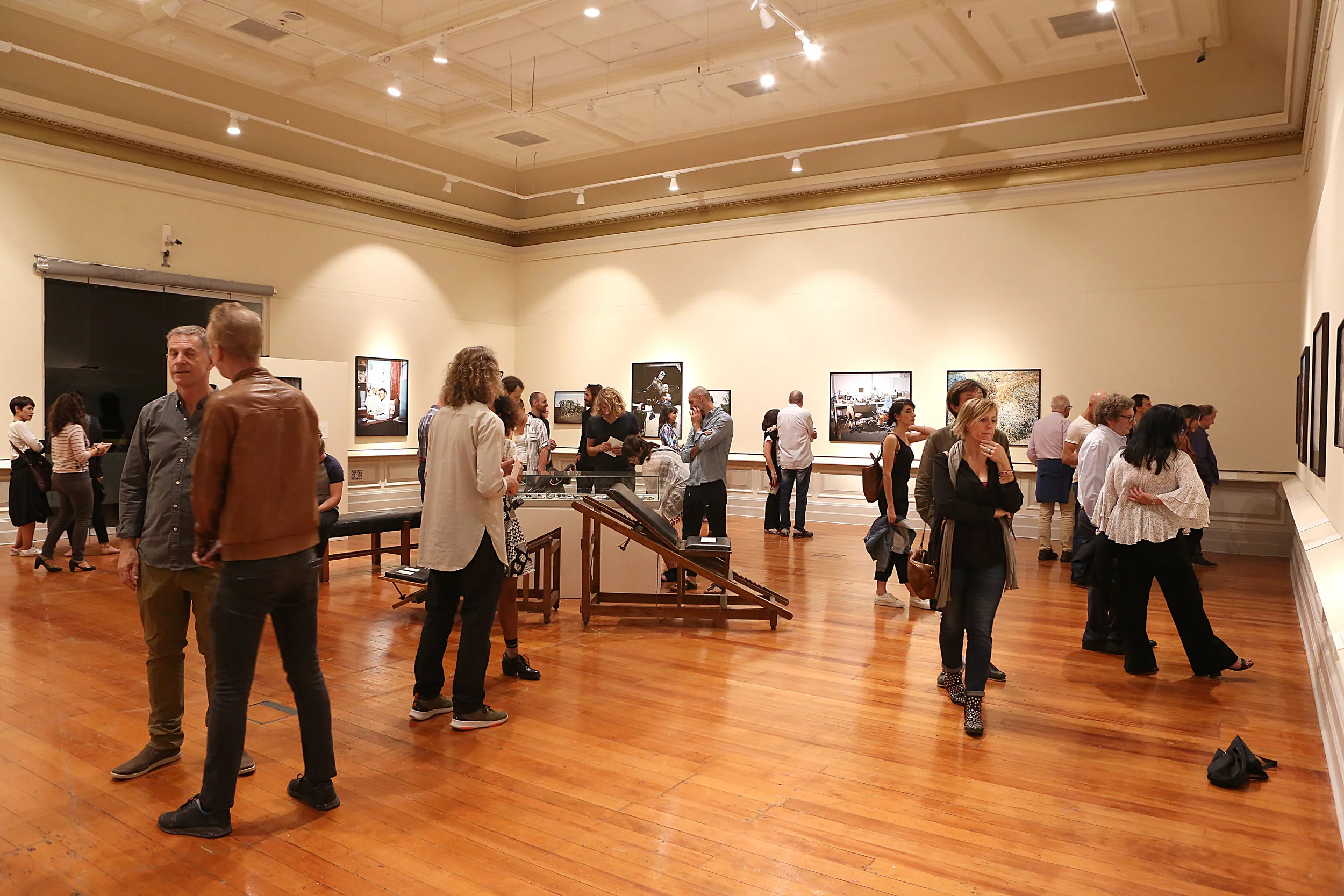
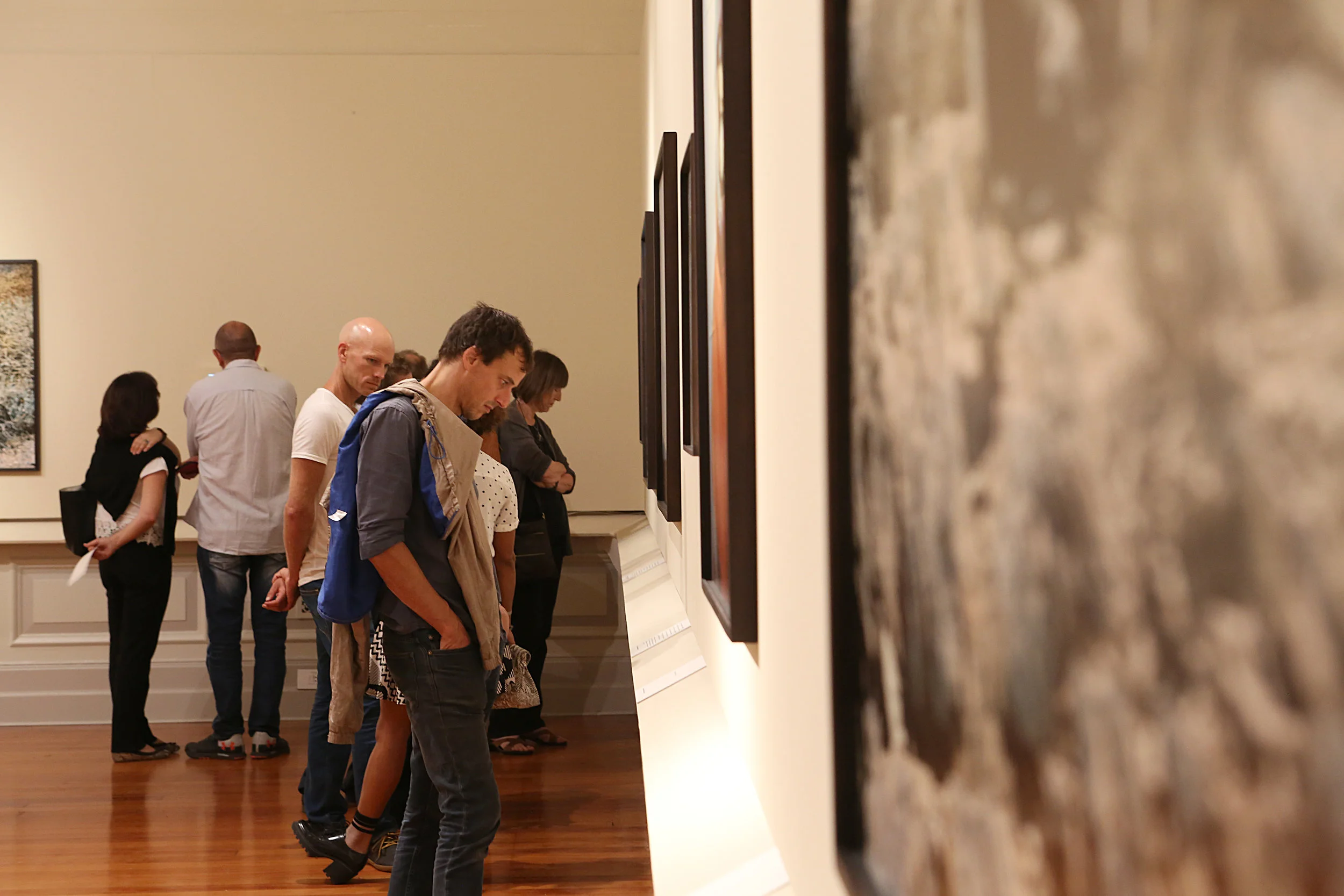
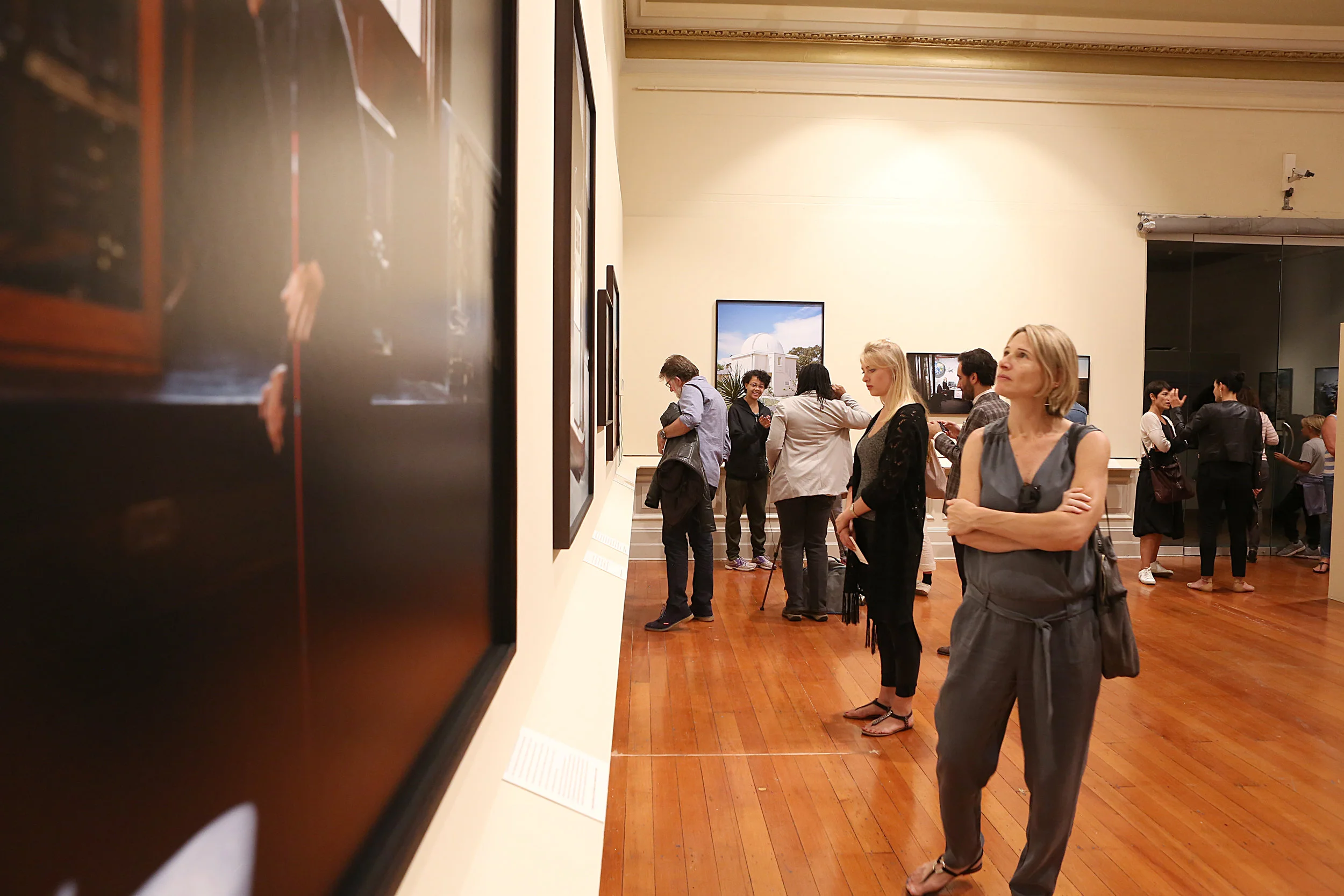
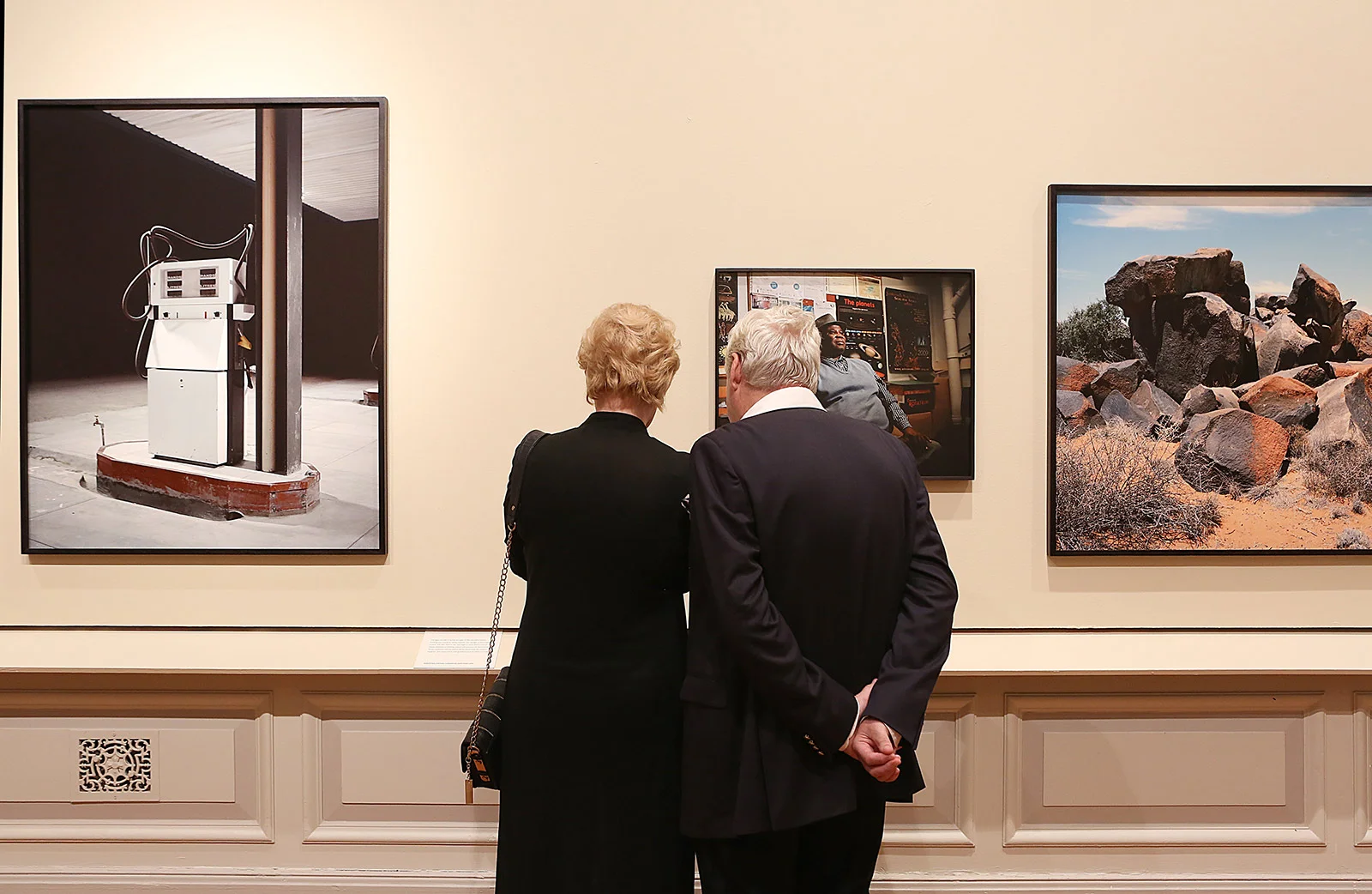
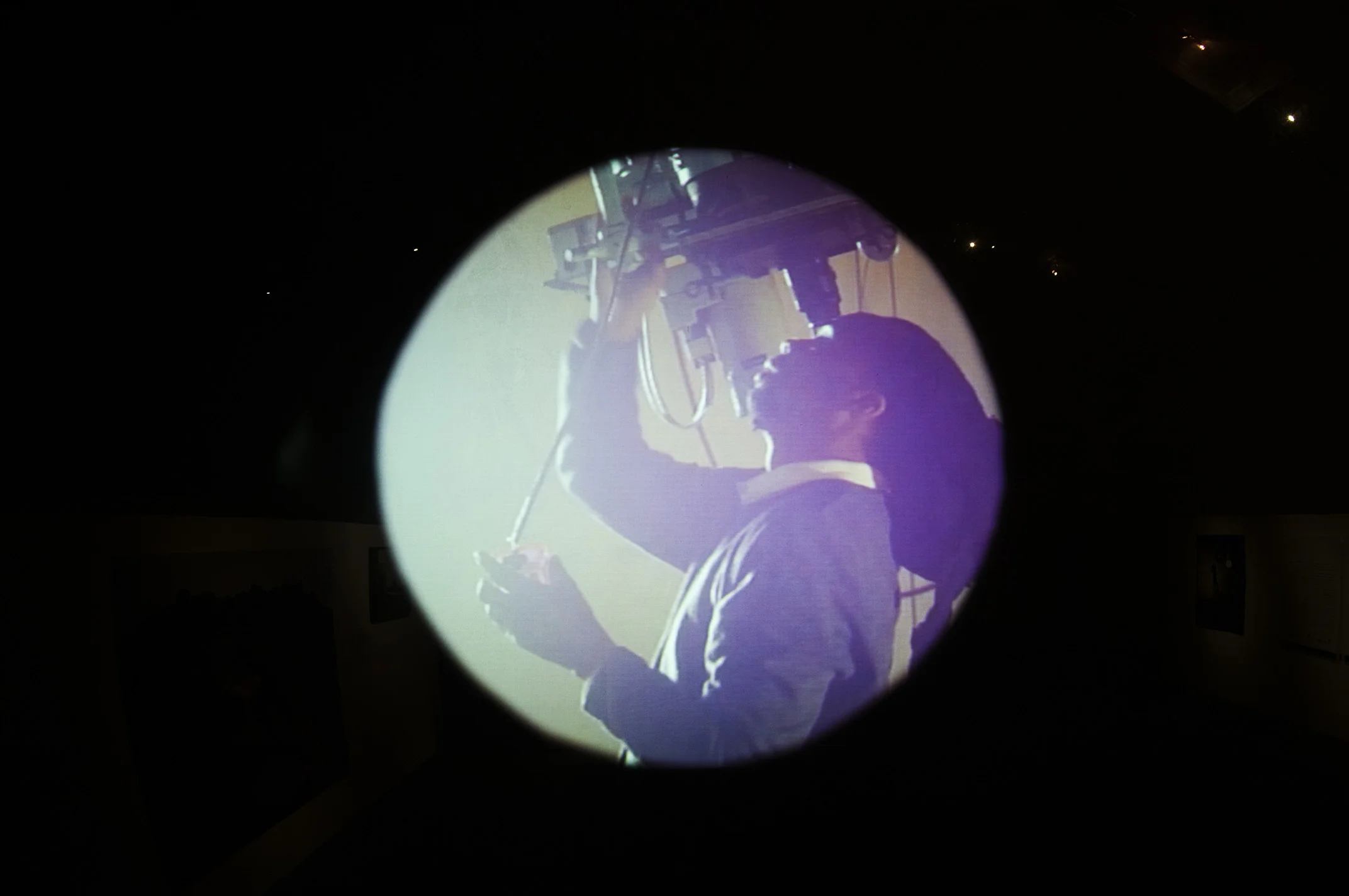
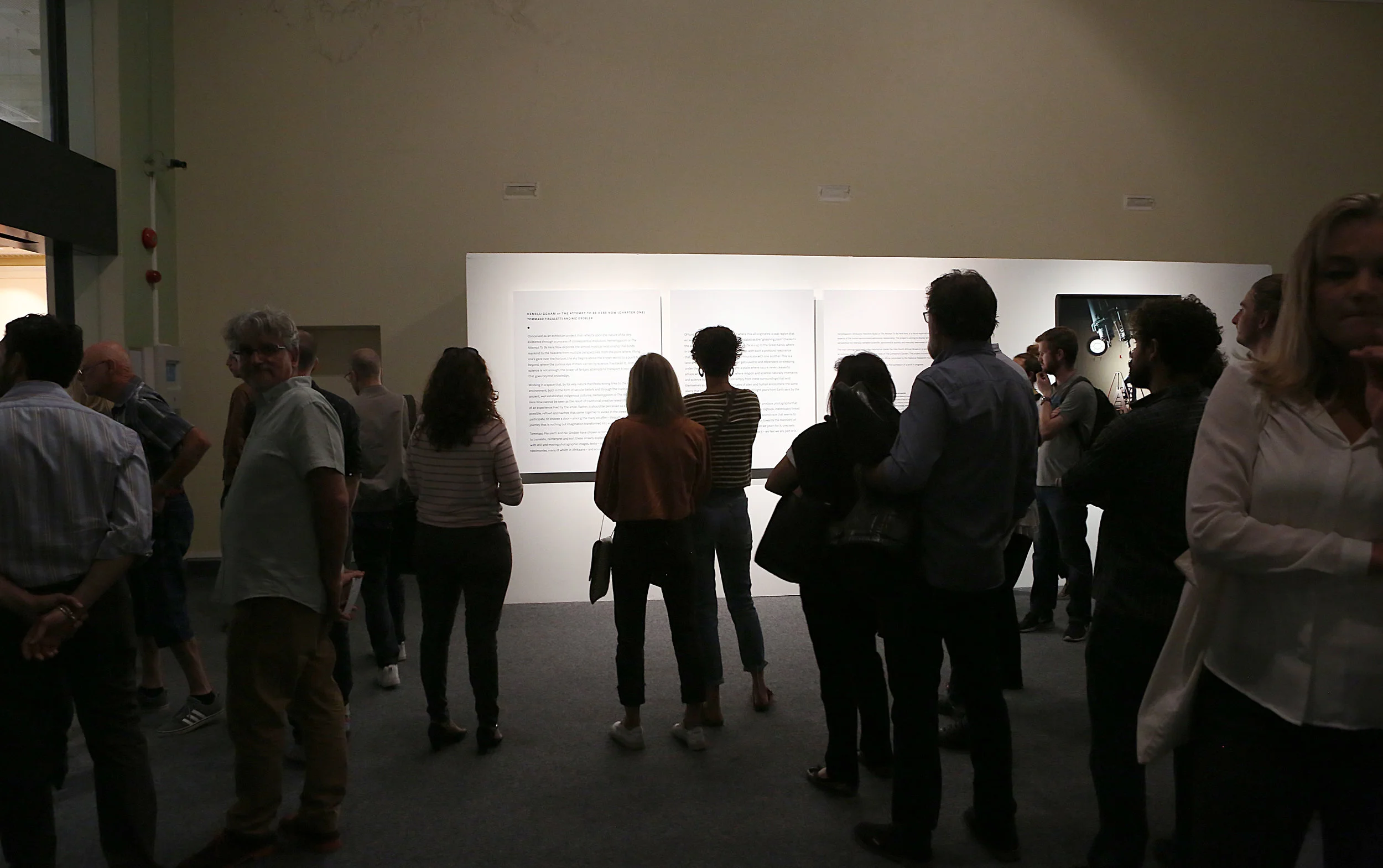
OPENING EVENING / Photos (c)Iziko Museums Of SA/Nigel Pamplin.
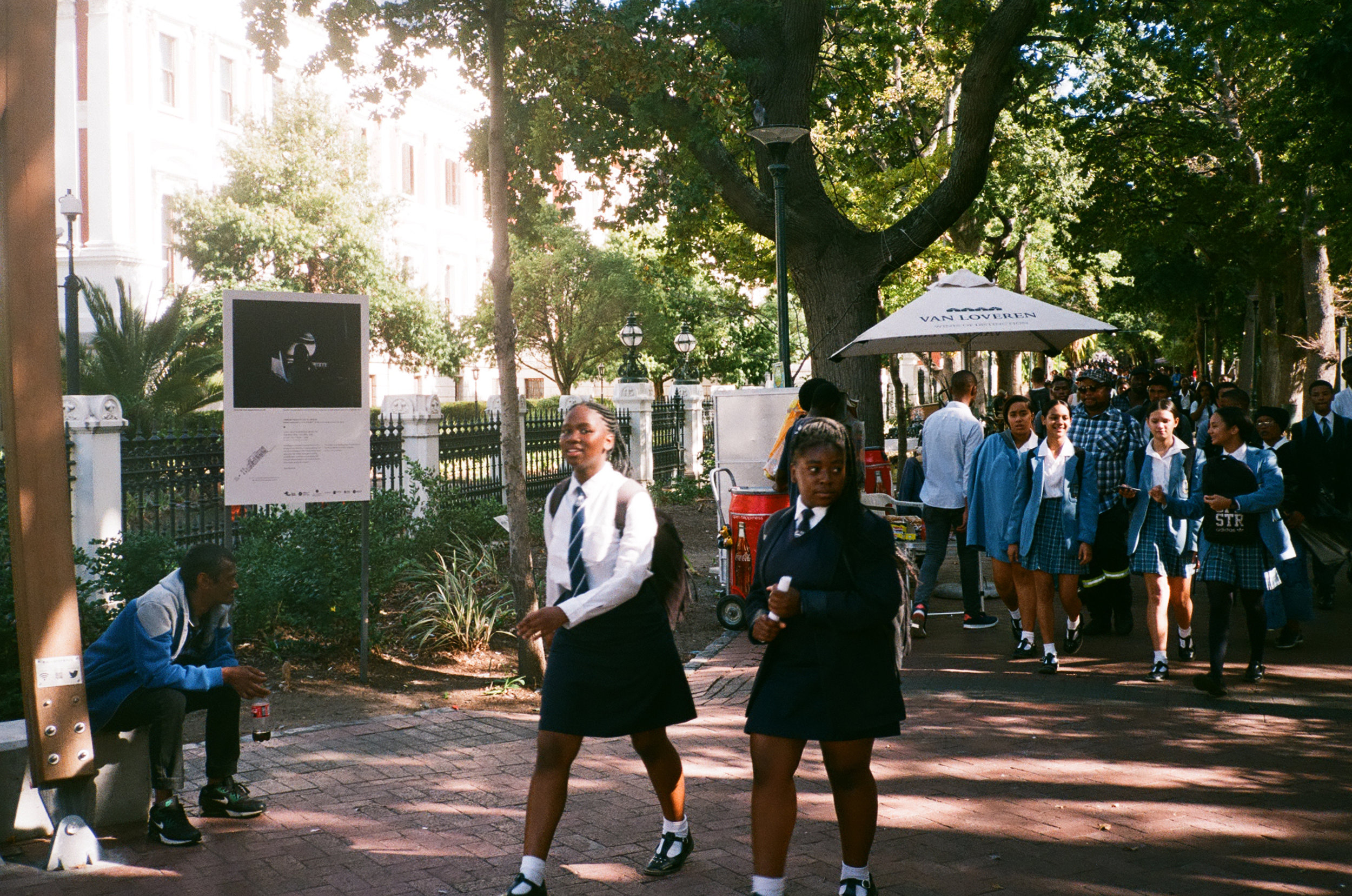
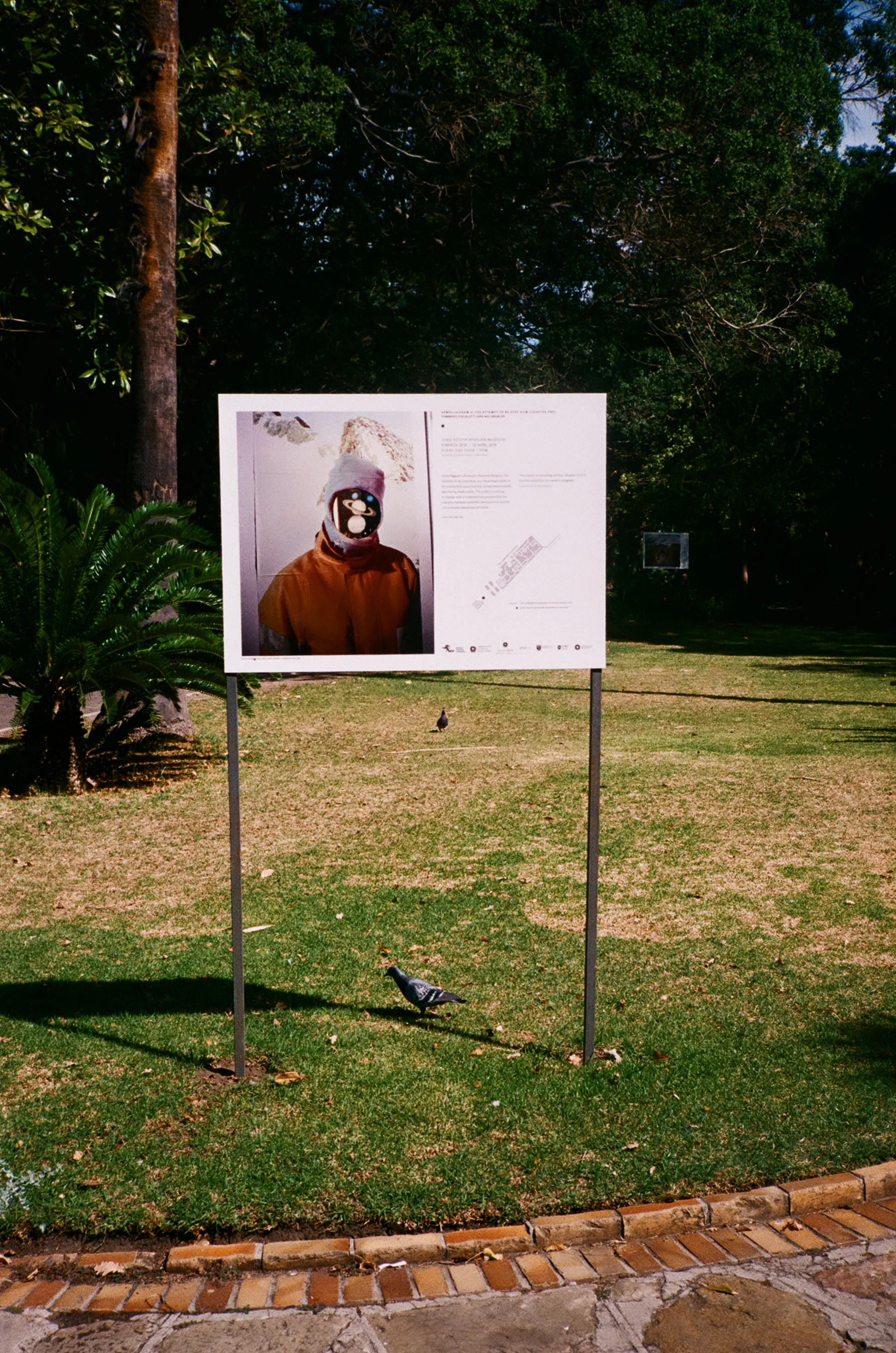
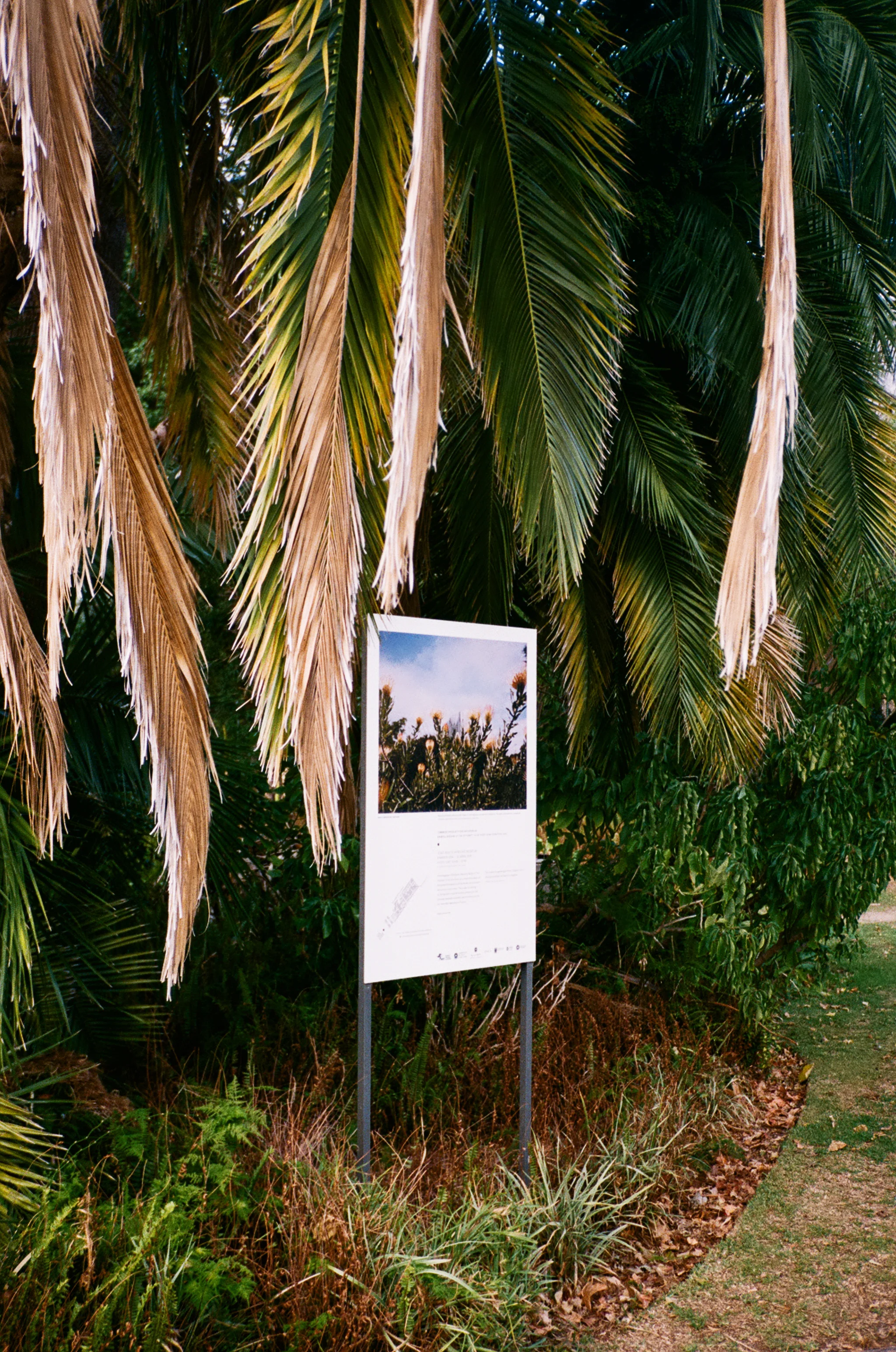
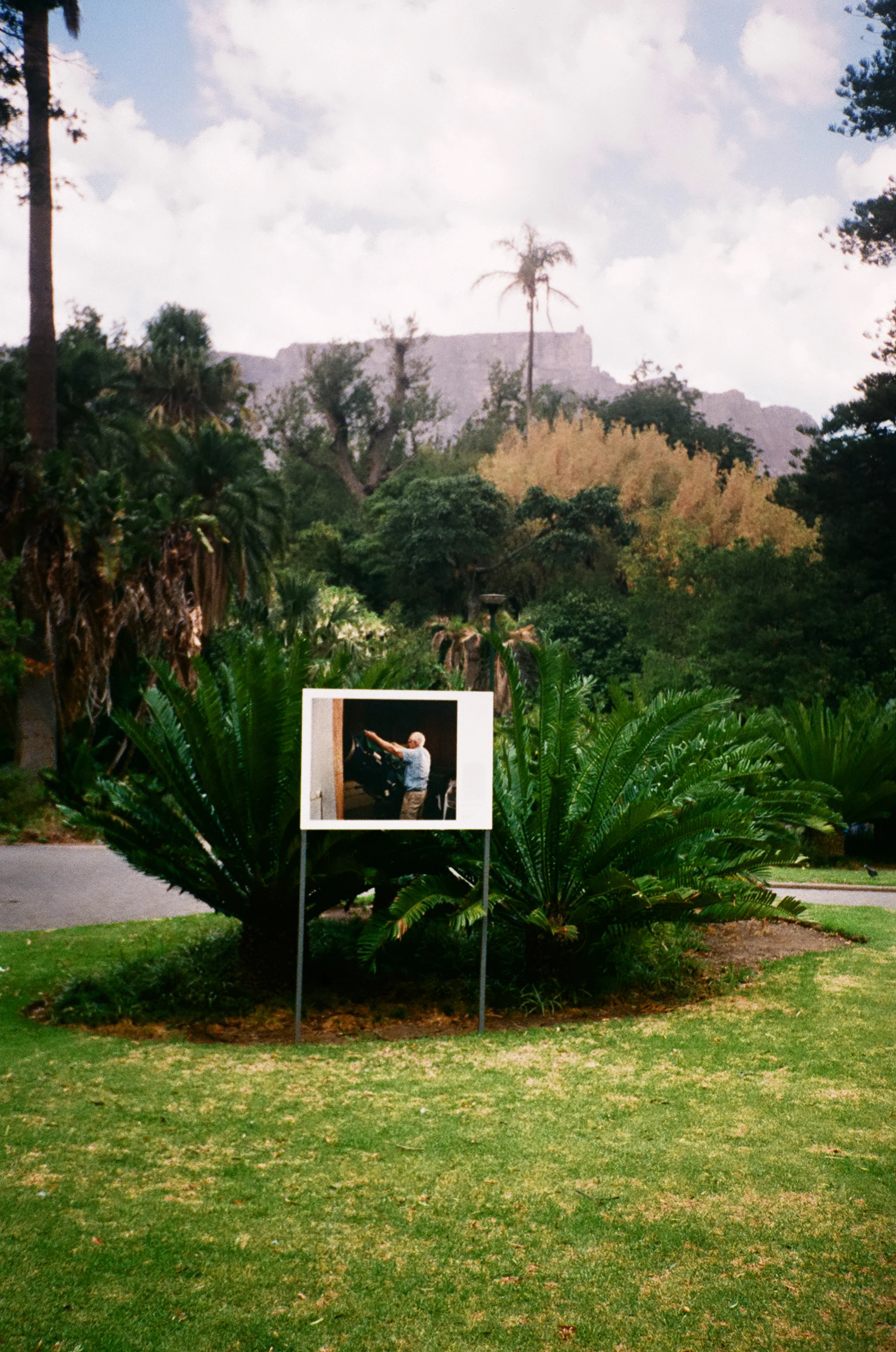
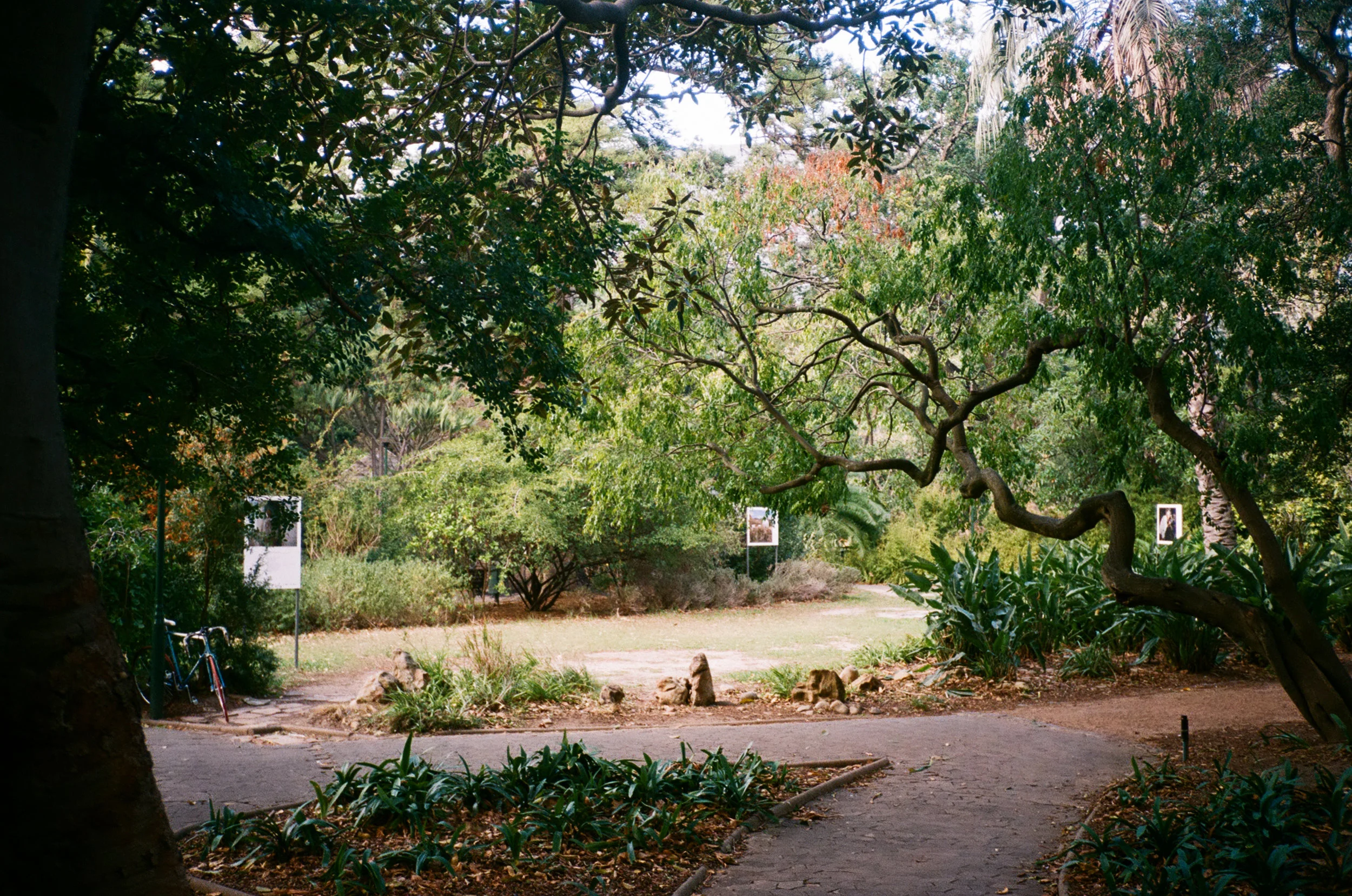
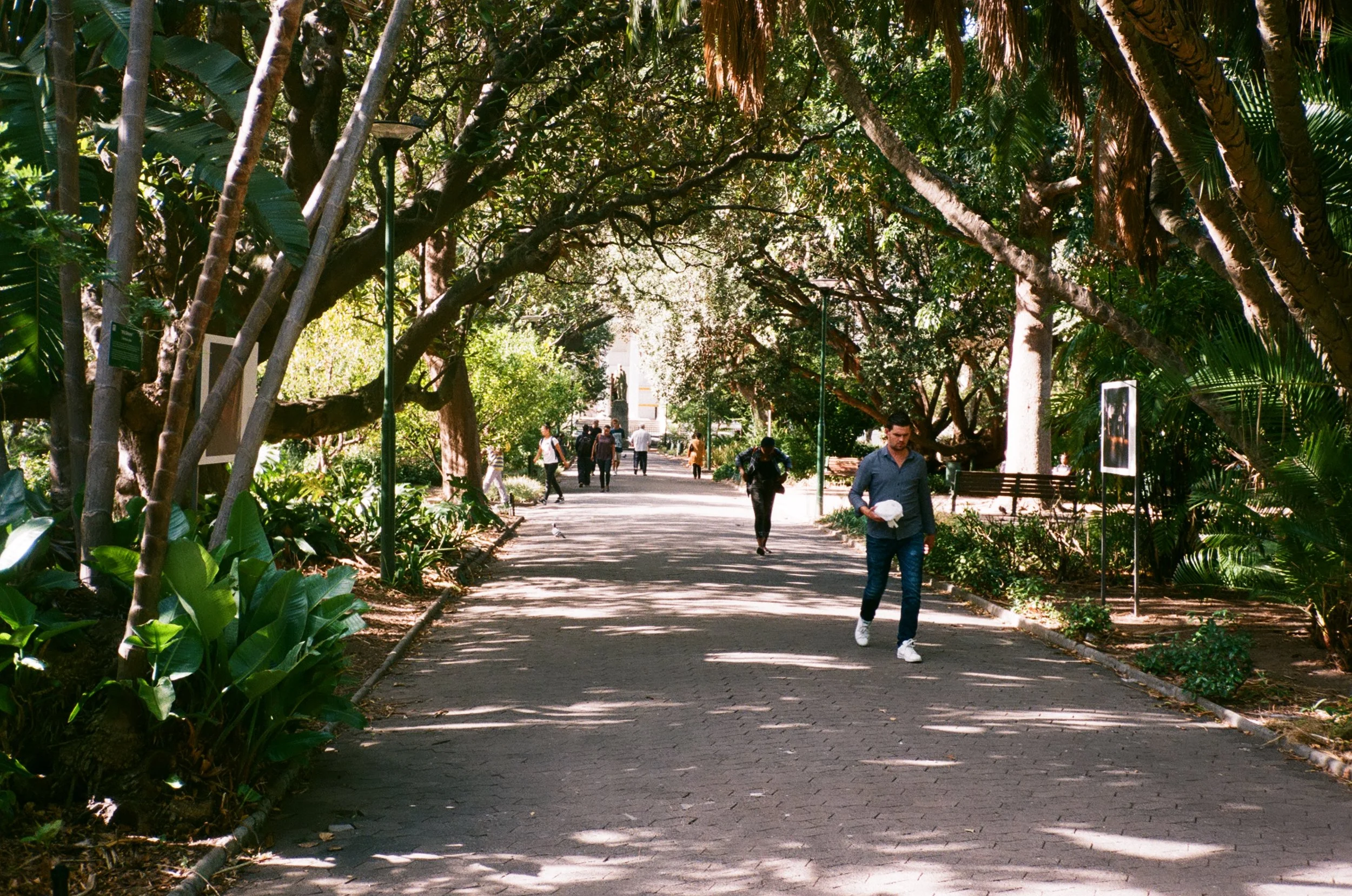
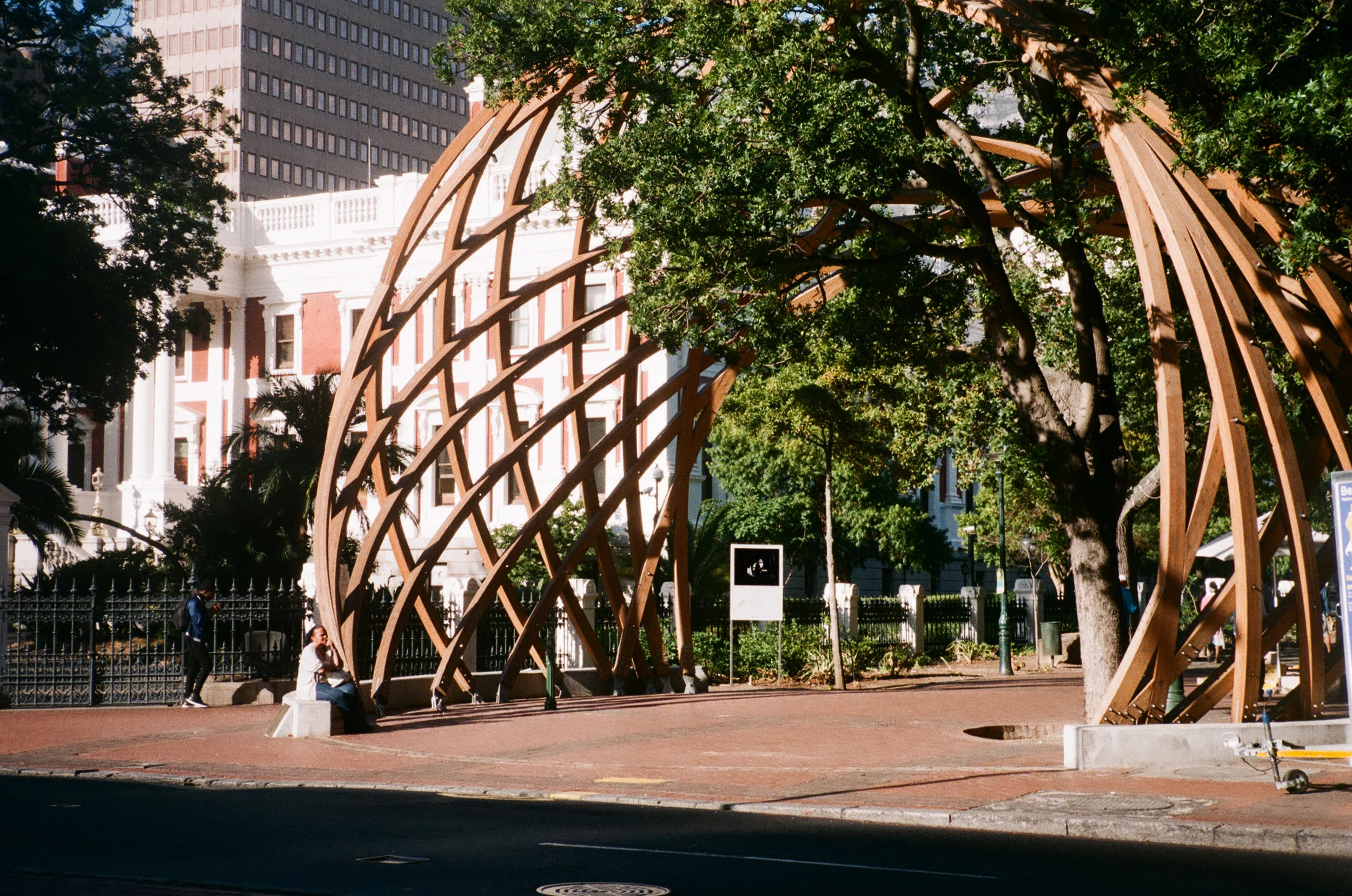
Outdoor Exhibition - The Company's Garden, Cape Town, 1 March - 22 May 2018
HEMELLIGGAAM or THE ATTEMPT TO BE HERE NOW (CHAPTER ONE)
TOMMASO FISCALETTI and NIC GROBLER
Conceived as an exhibition project that reflects upon the nature of its very existence through a process of consequential evolution, Hemelliggaam or The Attempt To Be Here Now explores the almost mystical relationship that binds mankind to the heavens from multiple perspectives: from the point where, lifting one’s gaze over the horizon, the sky begins above the known world, to a point far beyond, where the curious eye of man, carried by science, has taken it.
And when science is not enough, the power of fantasy attempts to transport it into a dimension that goes beyond knowledge.
Working in a space that, by its very nature manifests strong links to the natural environment, both in the form of secular beliefs and through the traditions of an ancient, well established indigenous cultures, Hemelliggaam or The Attempt To Be Here Now cannot be seen as the result of traditional creative research, or the result of an experience lived by the artist. Rather, it should be perceived as a series of possible, refined approaches that come together to evoke in the viewer the need to participate, to choose a door – among the many on offer – through which to start a journey that is nothing but imagination transformed into vision.
Tommaso Fiscaletti and Nic Grobler have chosen a complex list of media with which to translate, reinterpret and sort these already explicit elements. They have worked with still and moving photographic images, texts – original, unpublished and direct testimonies, many of which in Afrikaans –, and sounds.
Of fundamental significance is the land where this all originates: a vast region that extends from the Knersvlakte – literally translated as the "gnashing plain" thanks to the abundant quartz deposits that litter its surface – up to the Great Karoo, where in the north, the rocks make sounds like gongs with such a profound resonance that the early inhabitants used them to communicate with one another. This is a land where, to escape the heat, one soon gets used to and dependent on sleeping under the stars with every passing night; a place where nature never ceases to amaze with anthropomorphic forms, where religion and science naturally intertwine, and science fiction draws inspiration simply from these surroundings that lend themselves as perfect backdrops for tales of aliens and human encounters; the aliens that probably received signals more than 100 light years from Earth sent by the astronomical sites that populate the Great Karoo.
Working in harmonious symbiosis, Fiscaletti and Grobler produce photographs that present themselves as strict and precise notes of a travel logbook, inextricably linked with video works, and including the choice of an original soundtrack that seems to embody the voice of the places explored. All this leads us towards the discovery of something that we know may never be revealed.
And yet we yearn for it, precisely because – and despite the fact that we cannot posess it –, we feel we are part of it.
FILIPPO MAGGIA
HEMELLIGGAAM or THE ATTEMPT TO BE HERE NOW (CHAPTER ONE)
TOMMASO FISCALETTI e NIC GROBLER
Immaginato come un progetto espositivo che al tempo medesimo riflette su se stesso e dunque va modificandosi step by step, Hemelliggaam or The attempt to be here now esplora da molteplici punti di osservazione la relazione quasi mistica che lega l’essere umano al cielo, da quando, alzando lo sguardo oltre l’orizzonte, il cielo ha inizio sopra il mondo conosciuto, sino a dove l’occhio indagatore dell’uomo, supportato dalla scienza, lo porta. E, quando la scienza non basta, la fantasia prova a trasportarlo oltre lo scibile.
Alimentandosi in un territorio che per natura propria manifesta forti legami con l’ambiente, in forma di credenze e tradizioni cardini secolari di un’antica cultura indigena ben consolidata, Hemelliggaam or the attempt to be here non può essere visto come il risultato di un tradizionale percorso di ricerca creativo, frutto di un’esperienza vissuta dall’artista, quanto come una serie di possibili, raffinati approcci che insieme concorrono a evocare nello spettatore la necessità di partecipare, di scegliere una porta -fra le tante offerte- attraverso la quale iniziare un viaggio che altro non è se non l’immaginazione fattasi visione.
Tommaso Fiscaletti e Nic Grobler hanno scelto un registro molto complicato per tradurre, reinterpretare e ordinare questi elementi già così espliciti, lavorando con immagini fotografiche, immagini in movimento, testi -originali, inediti e sintesi di testimonianze, molti di questi in afrikaans-, suoni.
Il luogo in cui tutto questo ha origine è fondamentale: un’ampia regione che si estende dal Knersvlakte -che tradotto letteralmente vuol dire “pianura stridente” per la grande quantità di quarzo che ne ricopre la superficie- sino al Great Karoo, dove, a nord, le rocce sono come gong riflettenti tanto che i primi abitanti fra loro comunicavano grazie a questi suoni. Terre dove per il gran caldo ci si abitua a dormire sotto le stelle divenendone notte dopo notte dipendenti, dove la natura stupisce proponendosi con sembianze antropomorfe, la religione si mescola alla scienza, l’una con l’altra vicendevolmente, con naturalezza, e la fantascienza trae ispirazione solo guardandosi intorno, tanto quei luoghi si prestano quali scenari perfetti per racconti di alieni che incontrano gli umani.
Quegli stessi alieni cui, probabilmente, vengono inviati segnali a oltre 100 anni luce dalla Terra, dai siti astronomici che popolano il Great Karoo.
Lavorando in armonica simbiosi, Fiscaletti e Grobler producono fotografie che si presentano come appunti severi e precisi di un taccuino di viaggio e opere video altrettanto essenziali, pulite anche nella scelta di un sonoro originale che sembra essere la voce dei luoghi, conducendoci alla scoperta di qualcosa che, da subito, comprendiamo non verrà rivelato.
Eppure aneliamo ad esso, proprio perché, pur non possedendolo, sentiamo di esserne parte.
FILIPPO MAGGIA
THREE POSTERS 2.2 x 1.8m
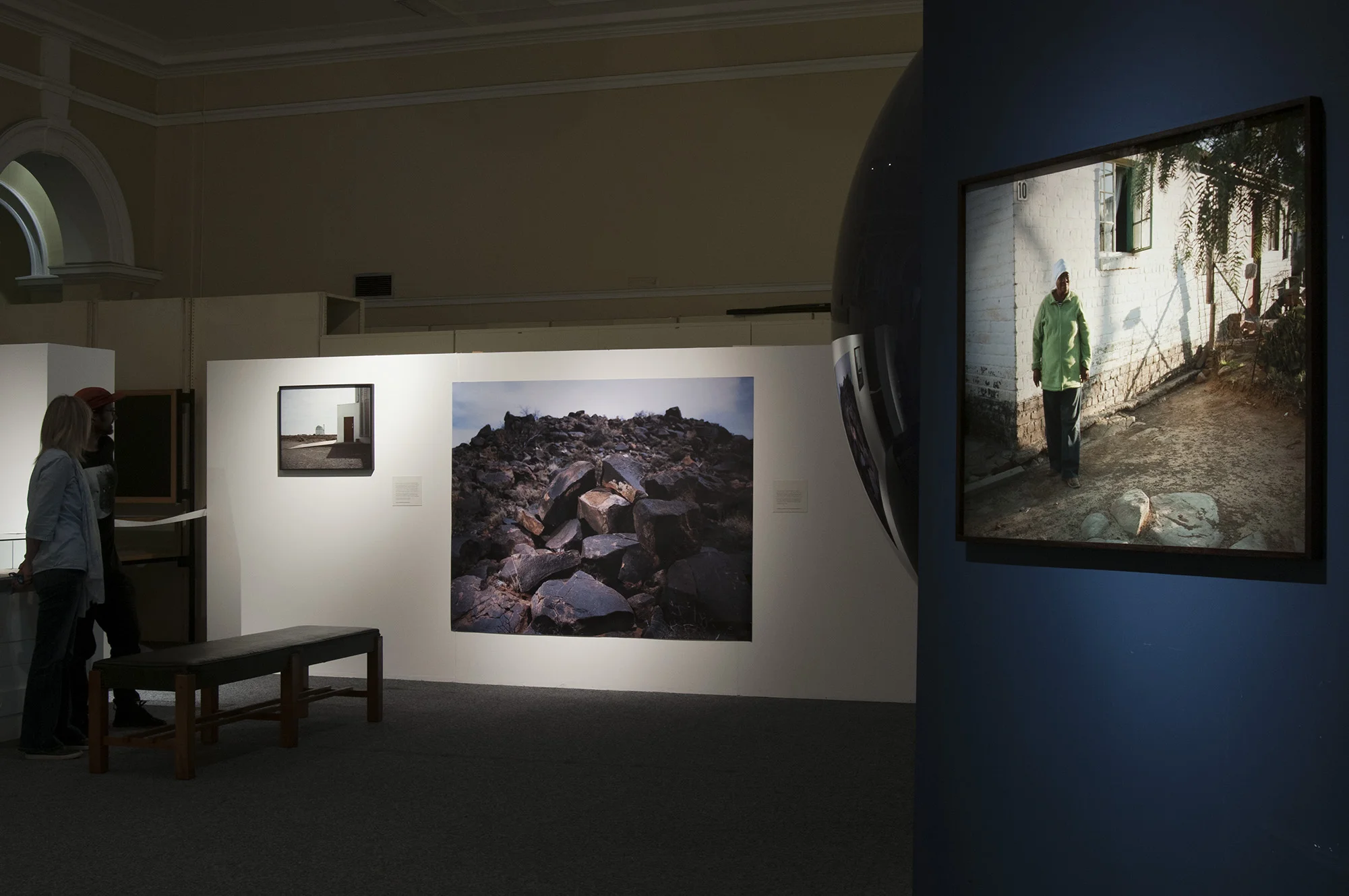
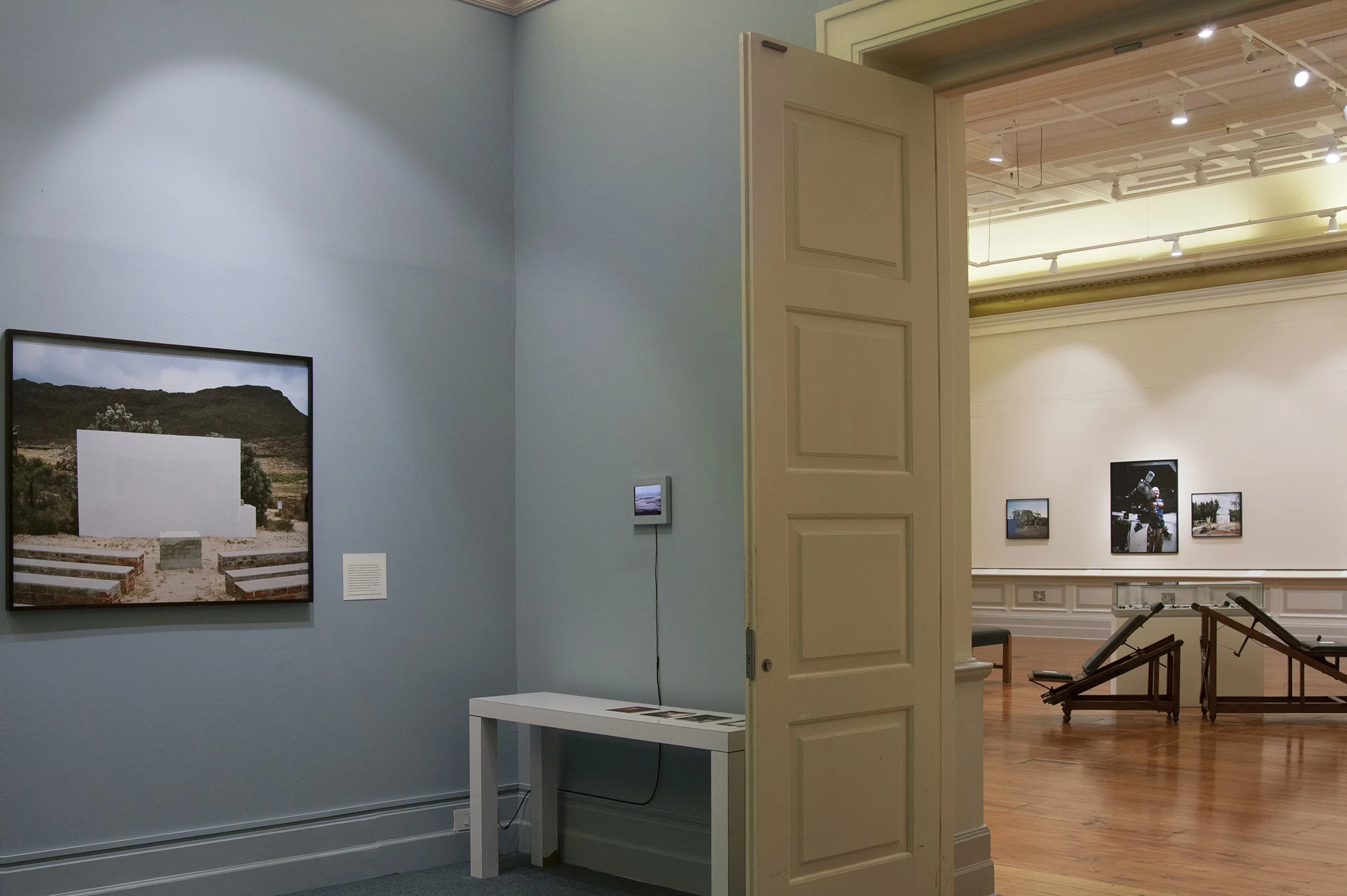
‘Knersvlakte’, literally translated from Afrikaans means “gnashing plain”. The name is said to originate from the crunching sound made by contact with the white, quartz-rich gravel. The quartz also reflects the sunlight, which makes the rocks and soil cooler in temperature than surrounding areas. This unique condition has allowed a large number of endemic plants to proliferate - many of these are small succulents that can absorb heat during the long and dry summers.
The R27 road passes through exceptionally desolate areas and is one of the main routes from Cape Town towards the SKA project site. Here, the first phase of the largest radio telescope in the world is planned for completion in around 2024.
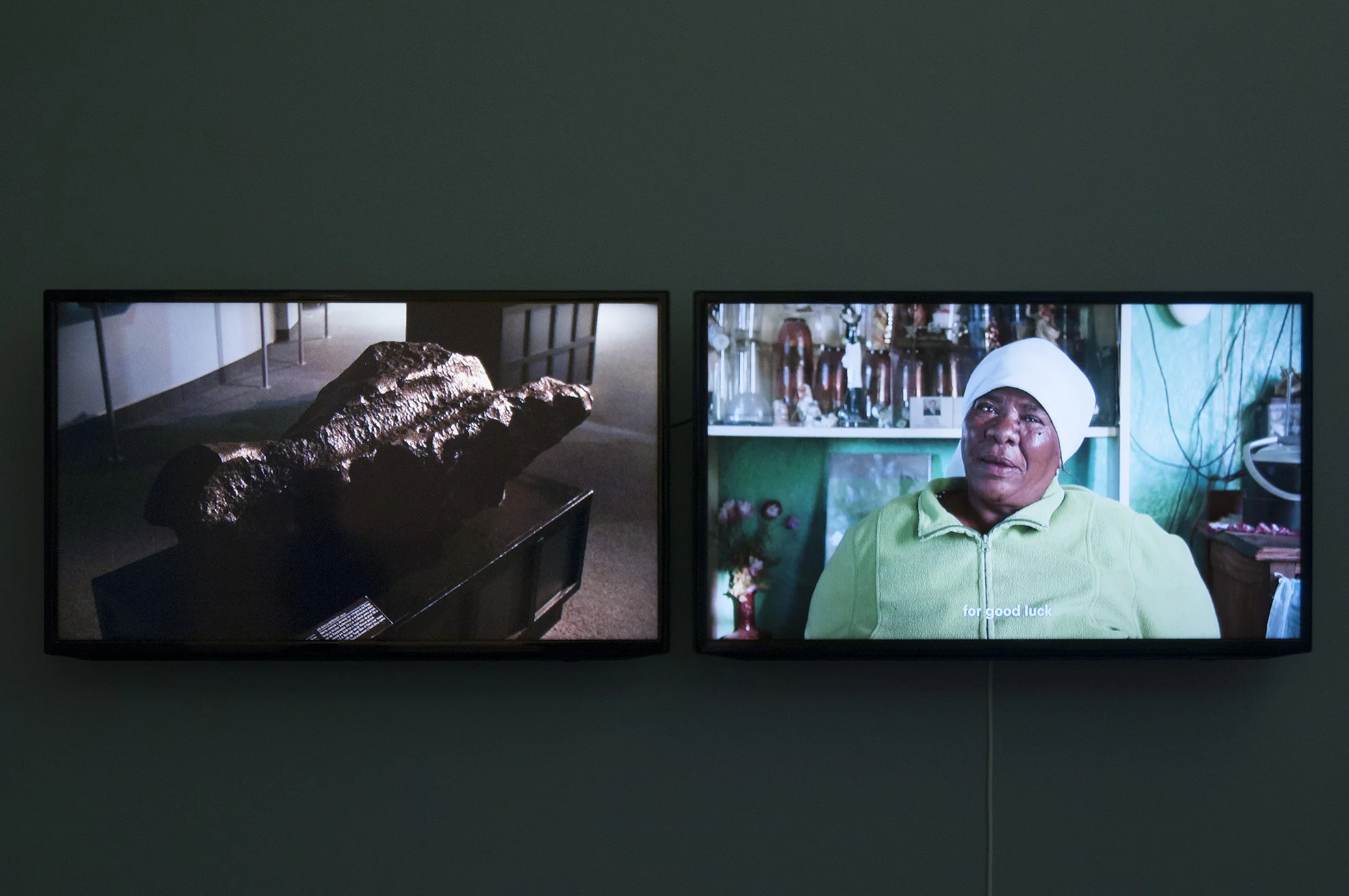
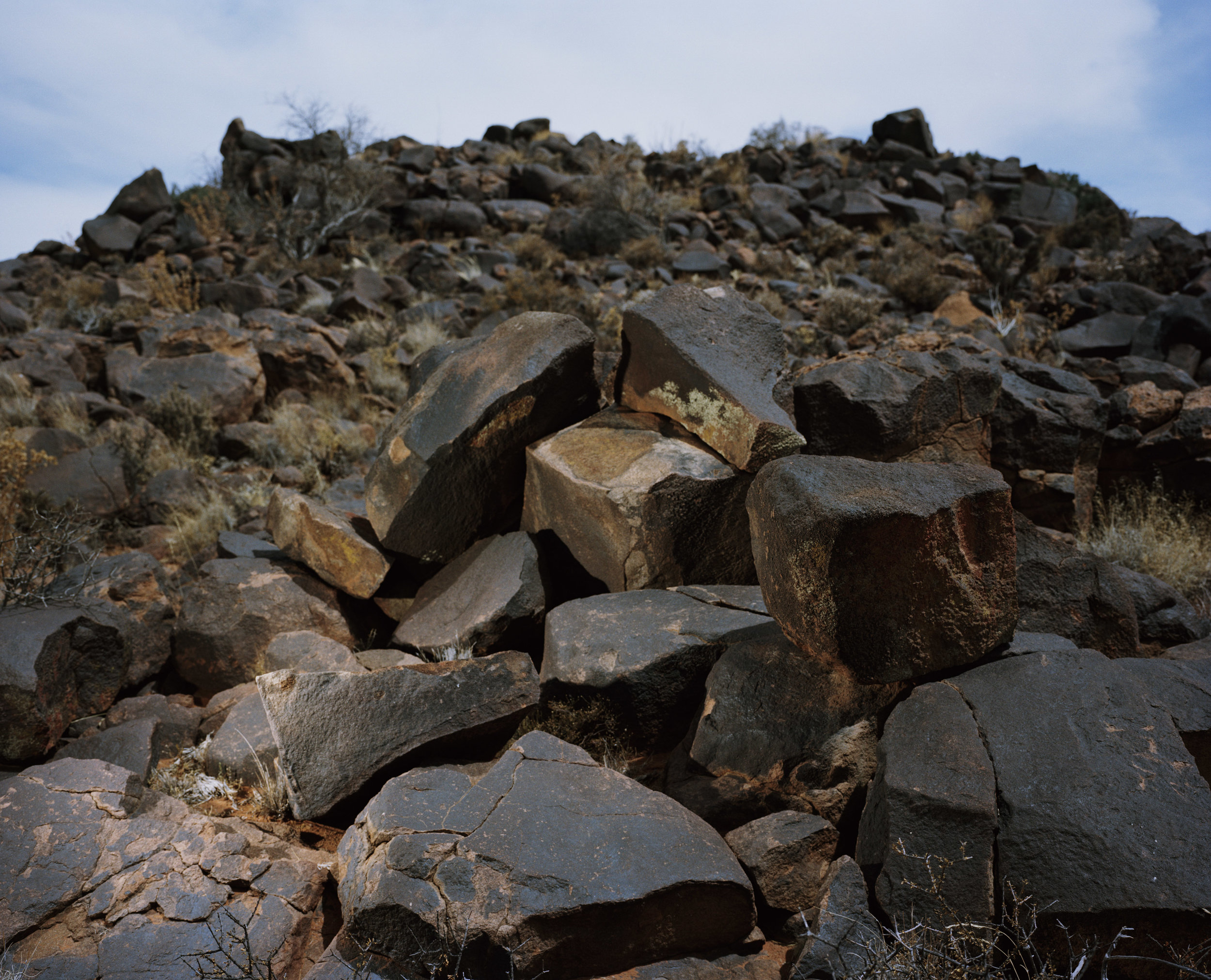
These rocks contain a high percentage of iron and their dark appearance forms a truly ancient landscape. The rocks make a metal sound when played; they are referred to with different names such as ‘rock gongs’, ‘ringing rocks’ or even ‘bushman pianos’. Found in various areas around the world and Africa, tradition formed around communicating with the help of the rocks - evident by the ancient drumming marks often found on them.
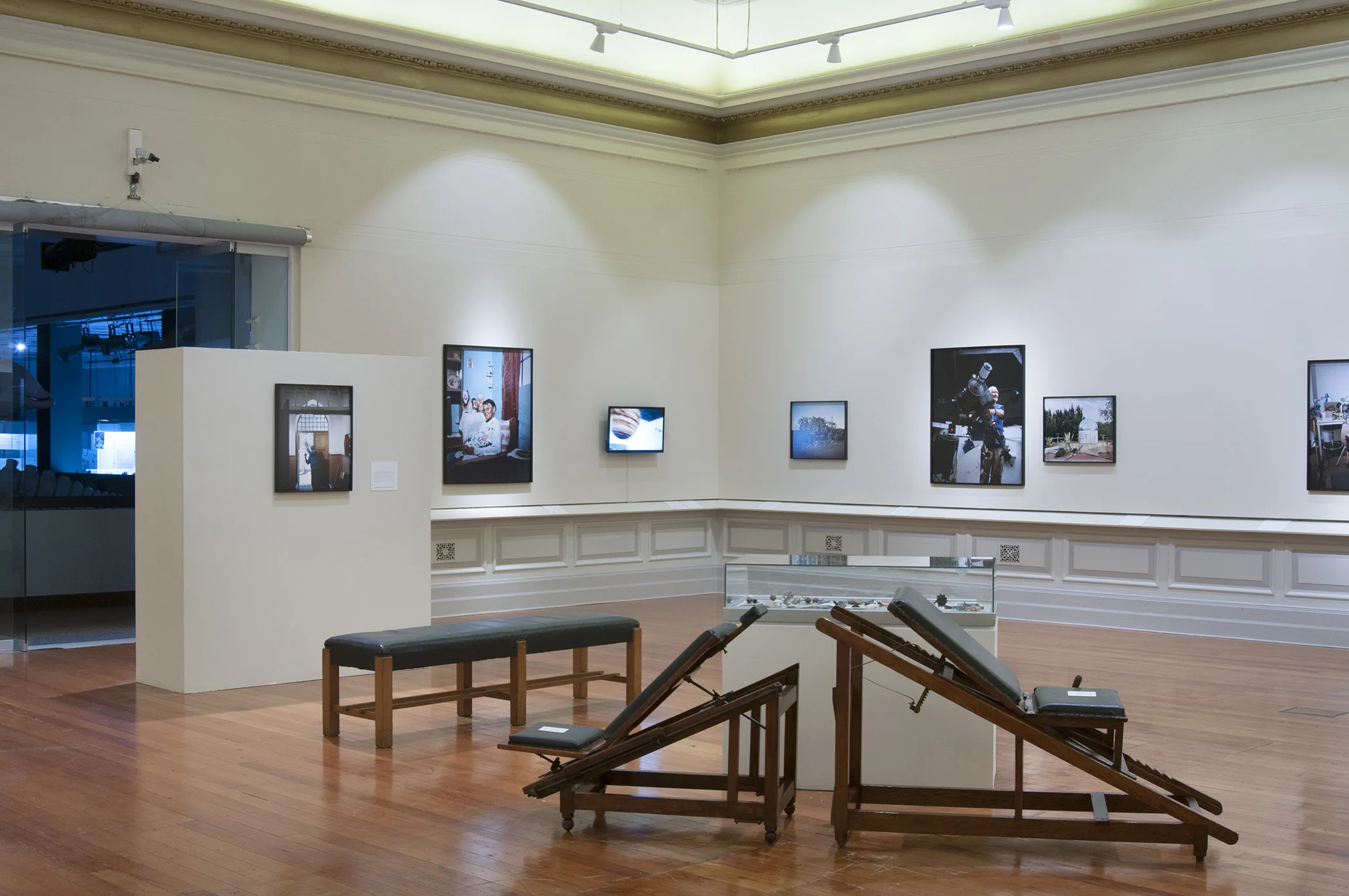
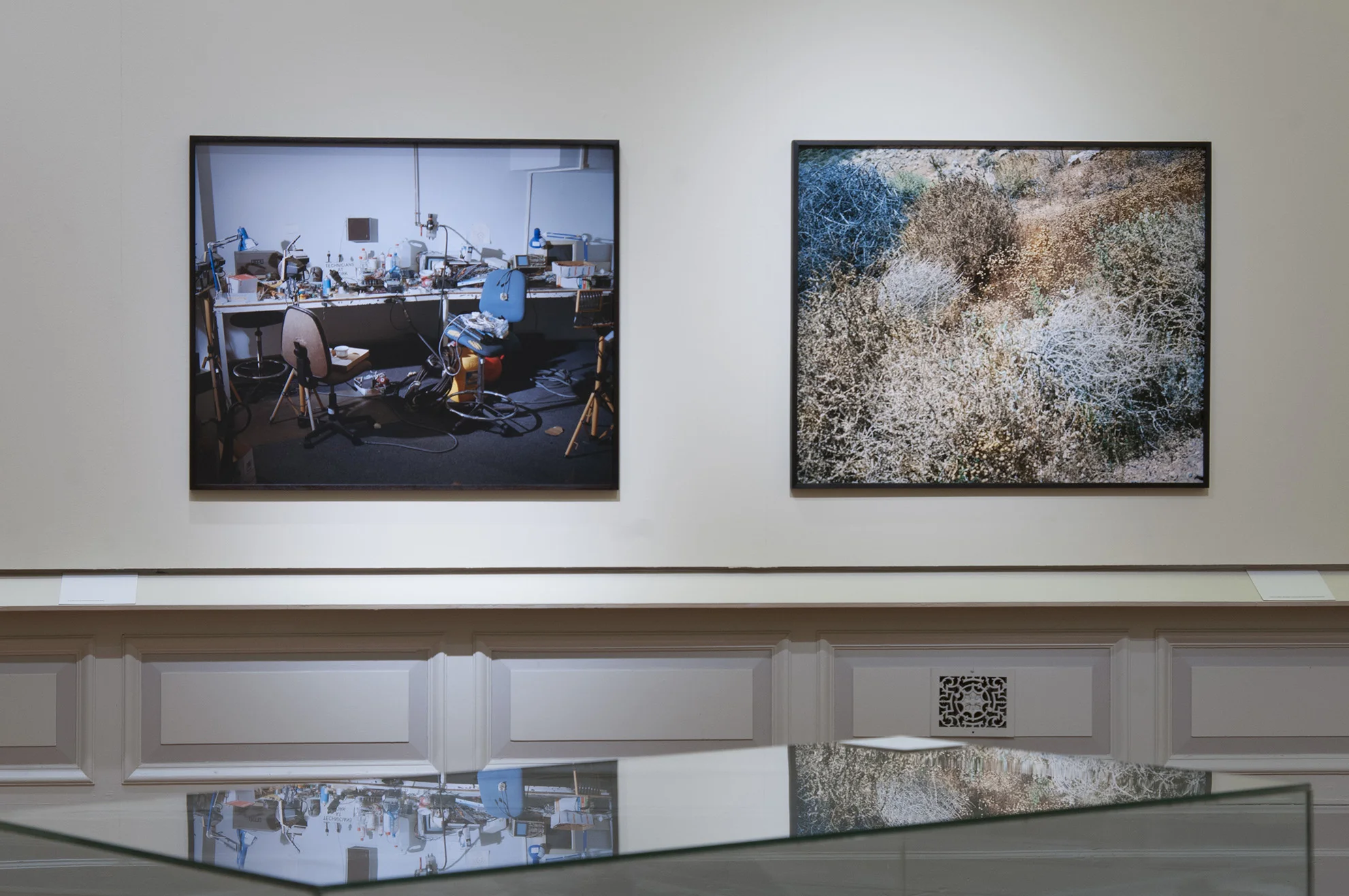
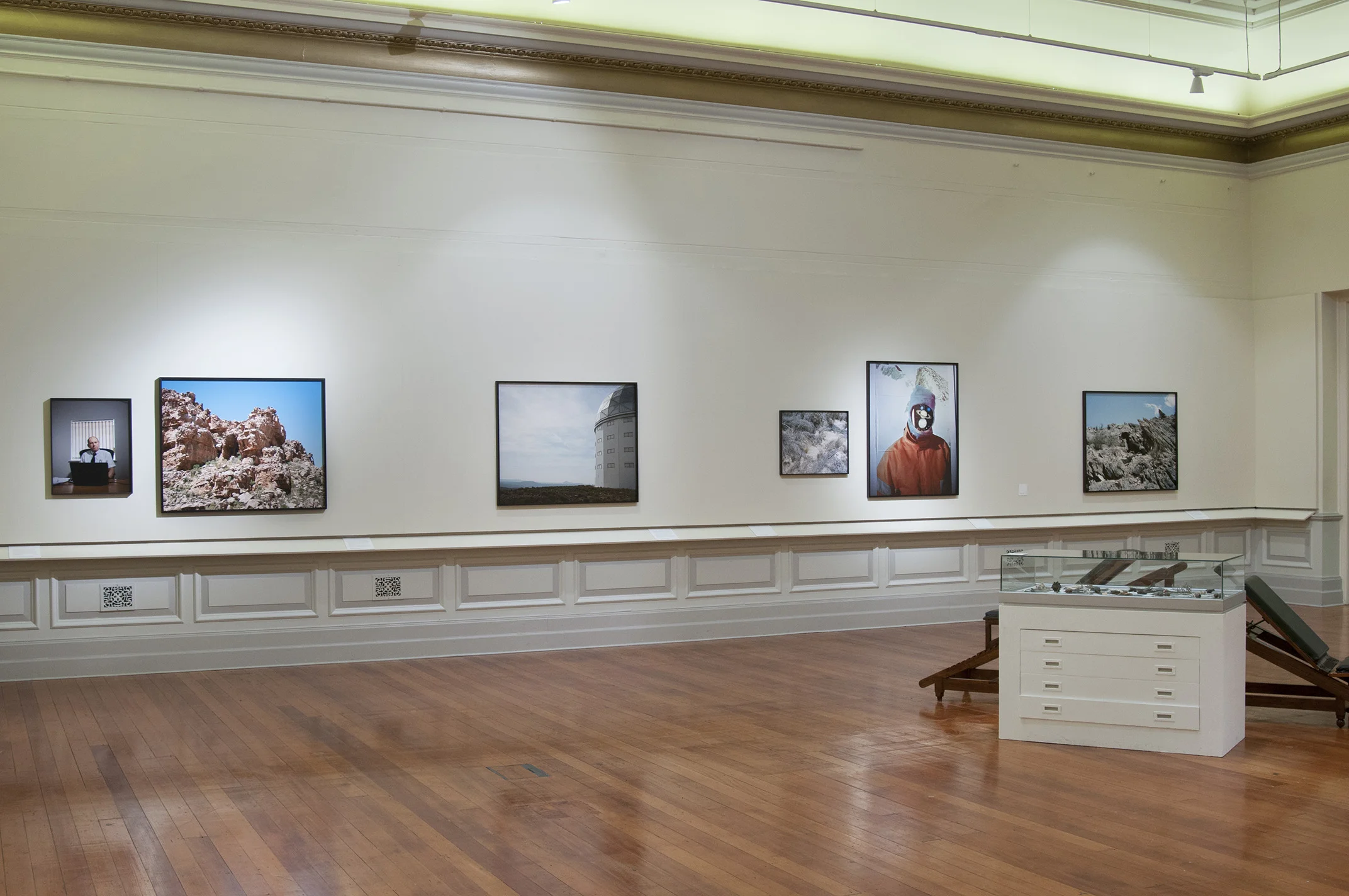
FRAMED PRINTS, LARGE AND SMALL. (120x97xm and 70x57cm)
'We saw it from far away, the dish - we saw it going up and then turning. Turning all around. It doesn't move fast - just slowly all around. It is very beautiful to see it happening.' - Abie Makok, Church Warder, United Reformed Church, Carnarvon, Northern Cape.
‘So I think it can form a basis for humanity, the world, to say that we all have a relationship with the stars and we have used stars for different purposes. If we start sharing those experiences, those practices, those stories - it is one way in which we can unite our people.’
Sivuyile Manxoyi, South African Astronomical Observatory, SALT Collateral Benefits Programme
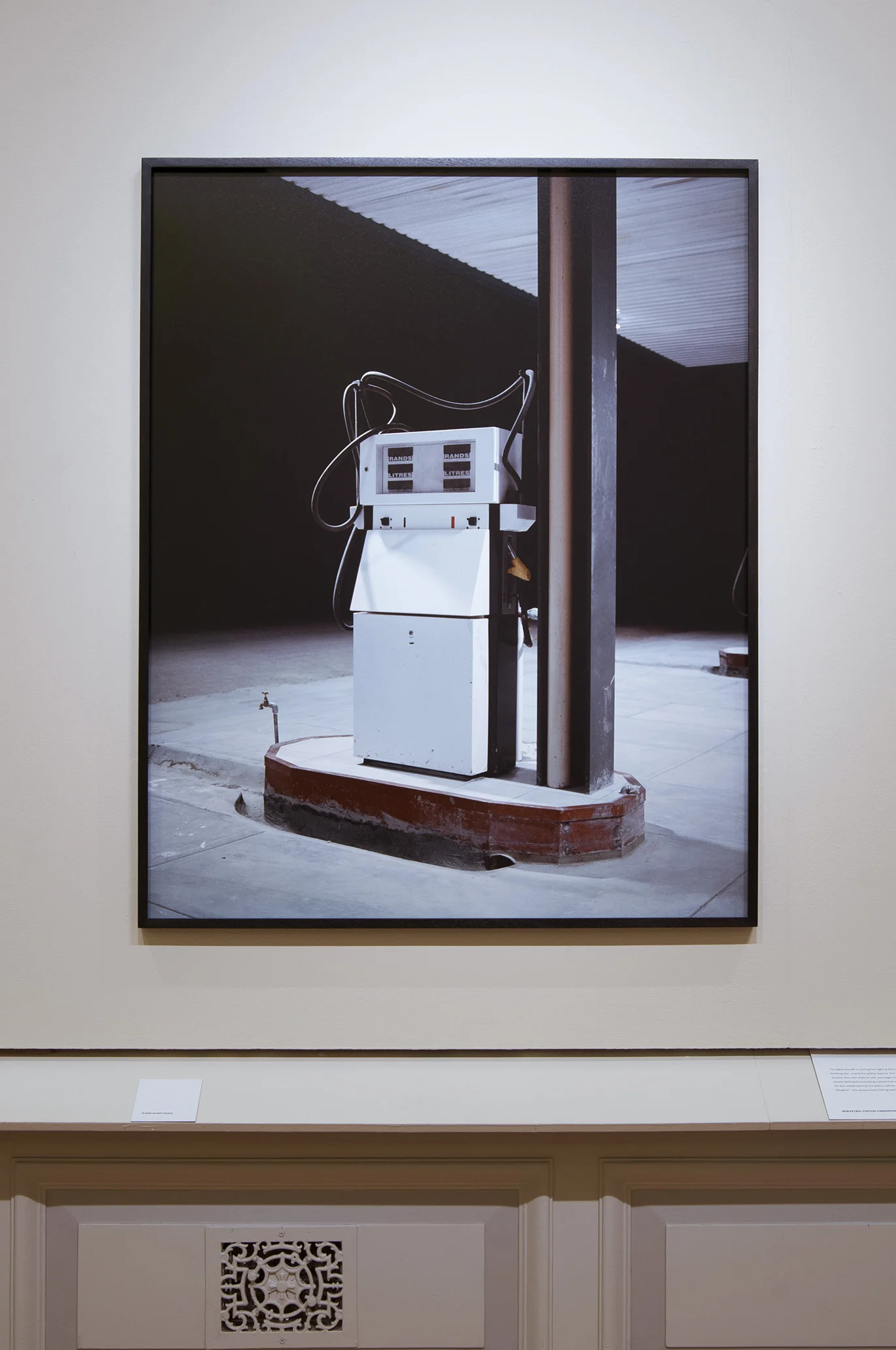
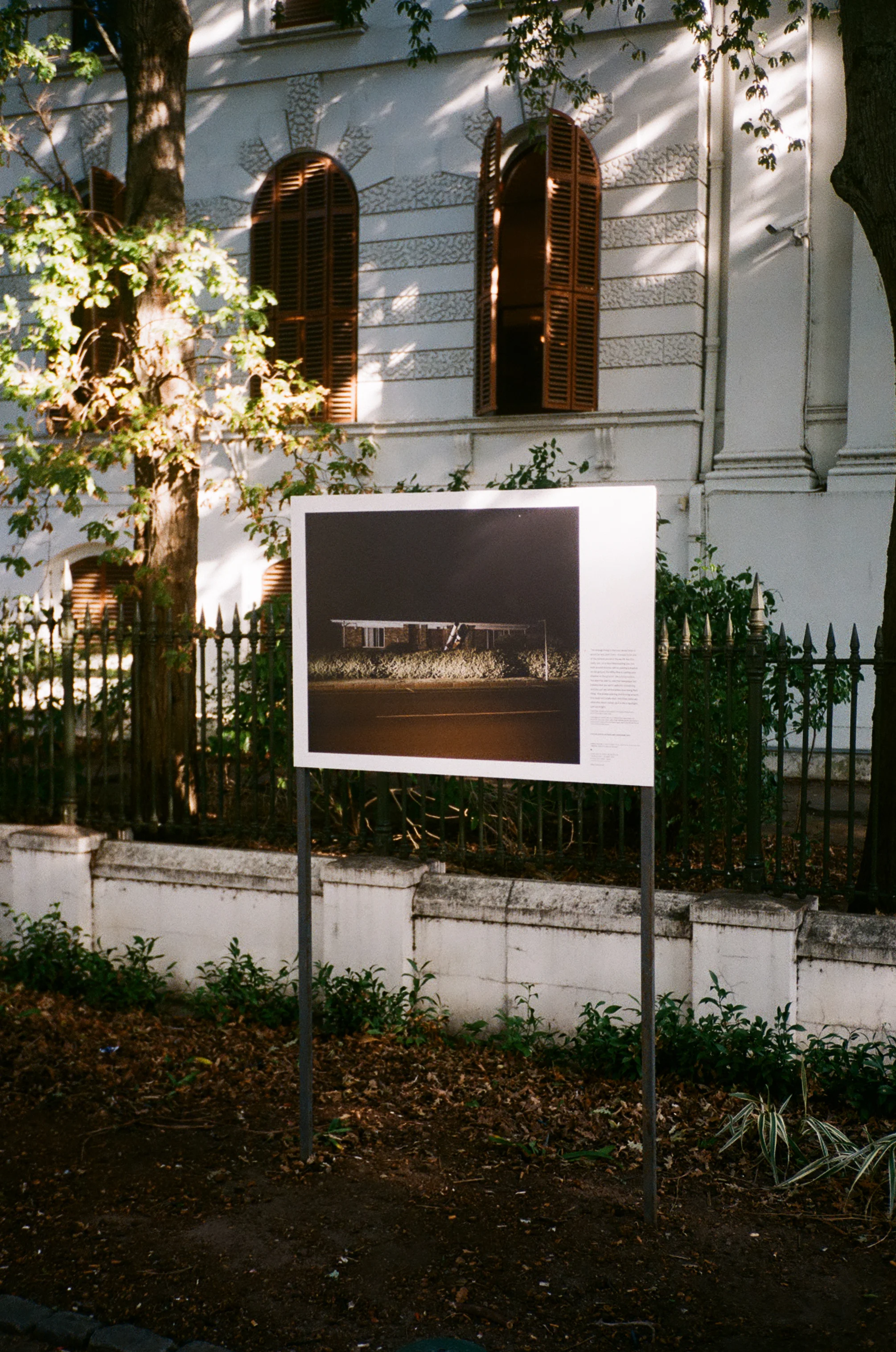
The lights are left on through the night at this new petrol station building site - mainly for safety. The manager of the building project, who also slept on site, was eager to show visitors around - clearly dedicated to building a place that everyone can be proud of. He also explained that the station will be named after the owner's daughter, who, as she grew up, really took a liking to the energy of the people working at stations of this kind.
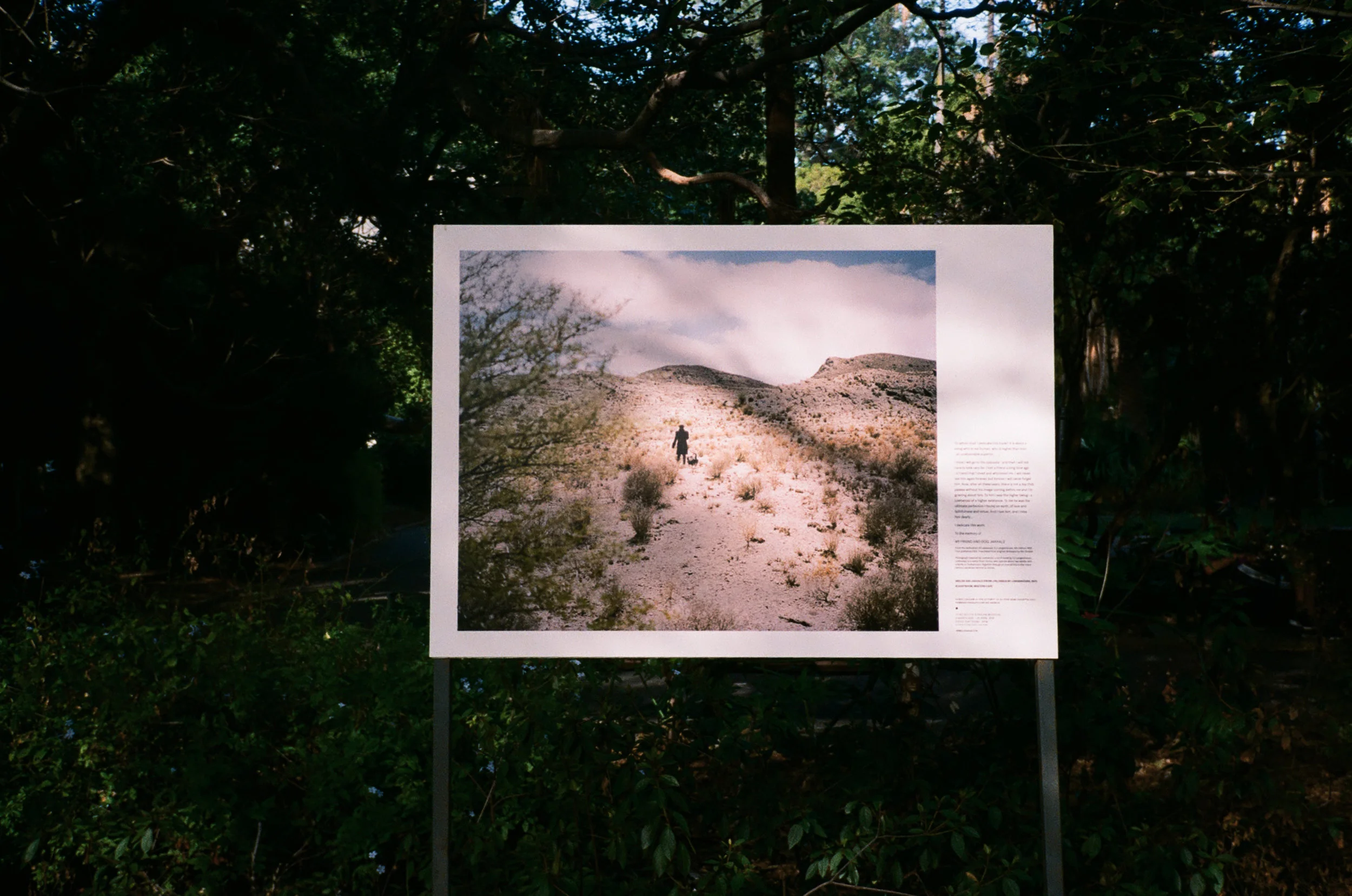
'To whom shall I dedicate this book? It is about a being who is not human, who is higher than man - an unattainable superior.
I think I will go to the opposite - and then I will not have to look very far. I lost a friend a long time ago - a friend that I loved and who loved me. I will never see him again forever; but forever I will never forget him. Now, after all these years, there is not a day that passes without his image coming before me and I'm grieving about him. To him I was the higher being - a Loeloeraai of a higher existence. To me he was the ultimate perfection I found on earth, of love and faithfulness and virtue. And I lost him, and I miss him dearly. . .
I dedicate this work:
To the memory of
MY FRIEND AND DOG, JAKHALS’
From the dedication of Loeloeraai, CJ Langenhoven, 4th Edition 1929, First published 1923. Translated from original Afrikaans by Nic Grobler.
Photograph inspired by Loeloeraai, CJ Langenhoven. Loeloeraai is a visitor from Venus, who spends about two weeks with a family in Oudtshoorn. They end up going on a small trip to the moon before Loeloeraai returns to Venus.
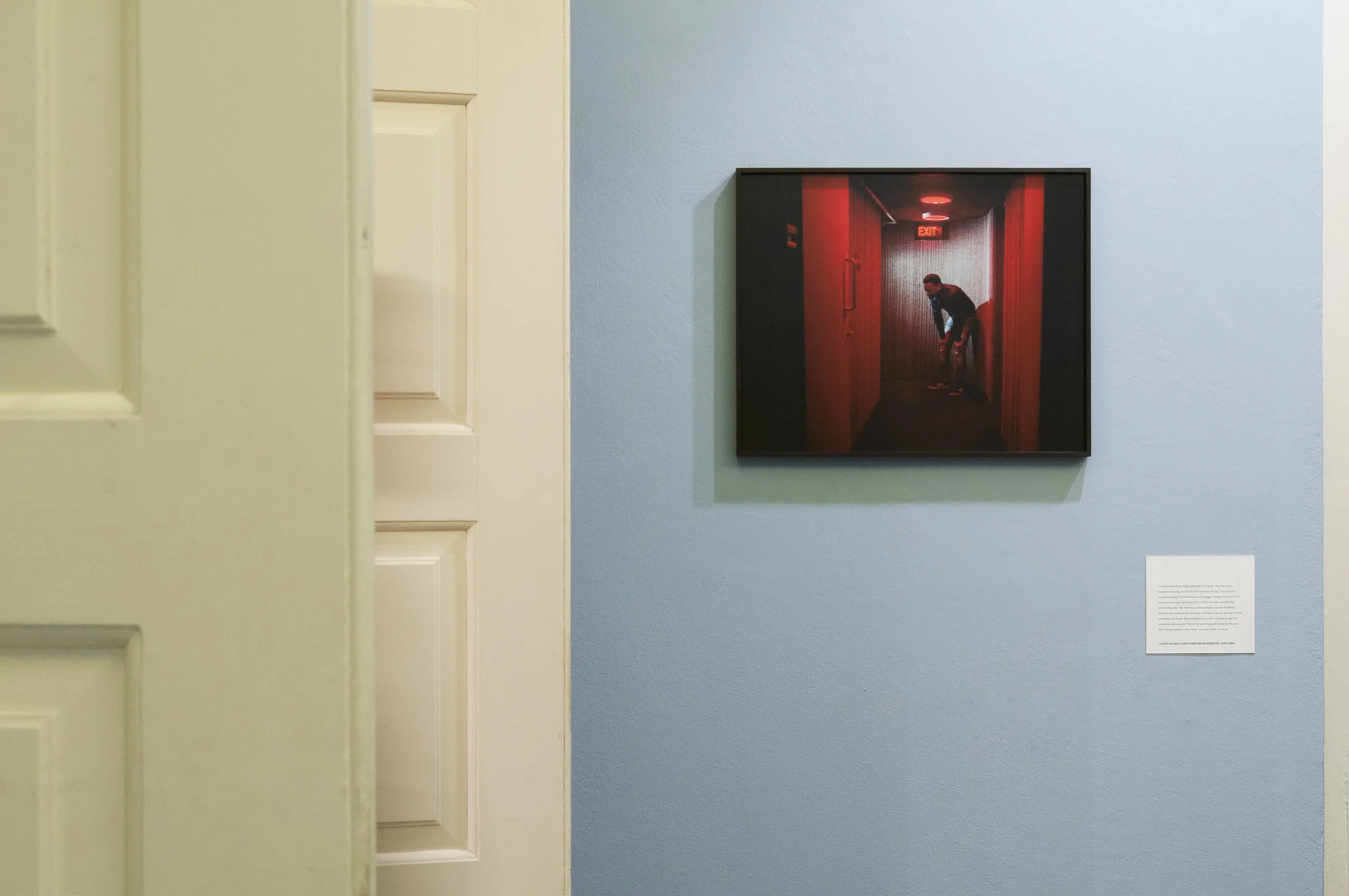
'I’ve learned a a lot about stars by coming here. I knew enough stars before so that I could point out a few, but here I got to learn more about them - about stars, what they are, what they are made of and so on. How they come about and into being. Before we were just learning names and constellations but here we were going deeper into it. Usually I just looked at them - without any understanding. Just you know, like if you looking at a tree that is standing there, you know that it is a tree, it is just there, it is a tree, you don’t really know what it does or anything. So I’ve got to learn more about stars, who they do and what their significance are in our lives and in the lives of everything around us. I understood that things were big you know - like the earth has got to be big, and South Africa has to be big - but without understanding that there were even bigger things out there. You know when you look at the sun, from a distance, like when it is on the horizon before it sets. You are not exactly sure where it is and how it relates to you and your life - you just know it is something that is out there. You are so far away from it, you don’t actually know that is very big. You could fit like a million earths into the sun - that is how big it is. It is hard to grasp. You know you are part of this world, but the universe can feel like something else - far from you. Even at night, you are thinking: there is the universe and here am I. But all in all you are part of the universe, you know, the universe is you, the universe is me, the universe is around - the space we are living in is the universe. This is not just earth and your life and then the universe is over there - you are in the universe. So in terms of understanding the whole universe like that. Ja… ja… a very very big place you know - really no one can understand how big it is, like fully understand. You can talk numbers, like 13,7 billion light years - what is that? You don’t know, but it’s big, something very big.’
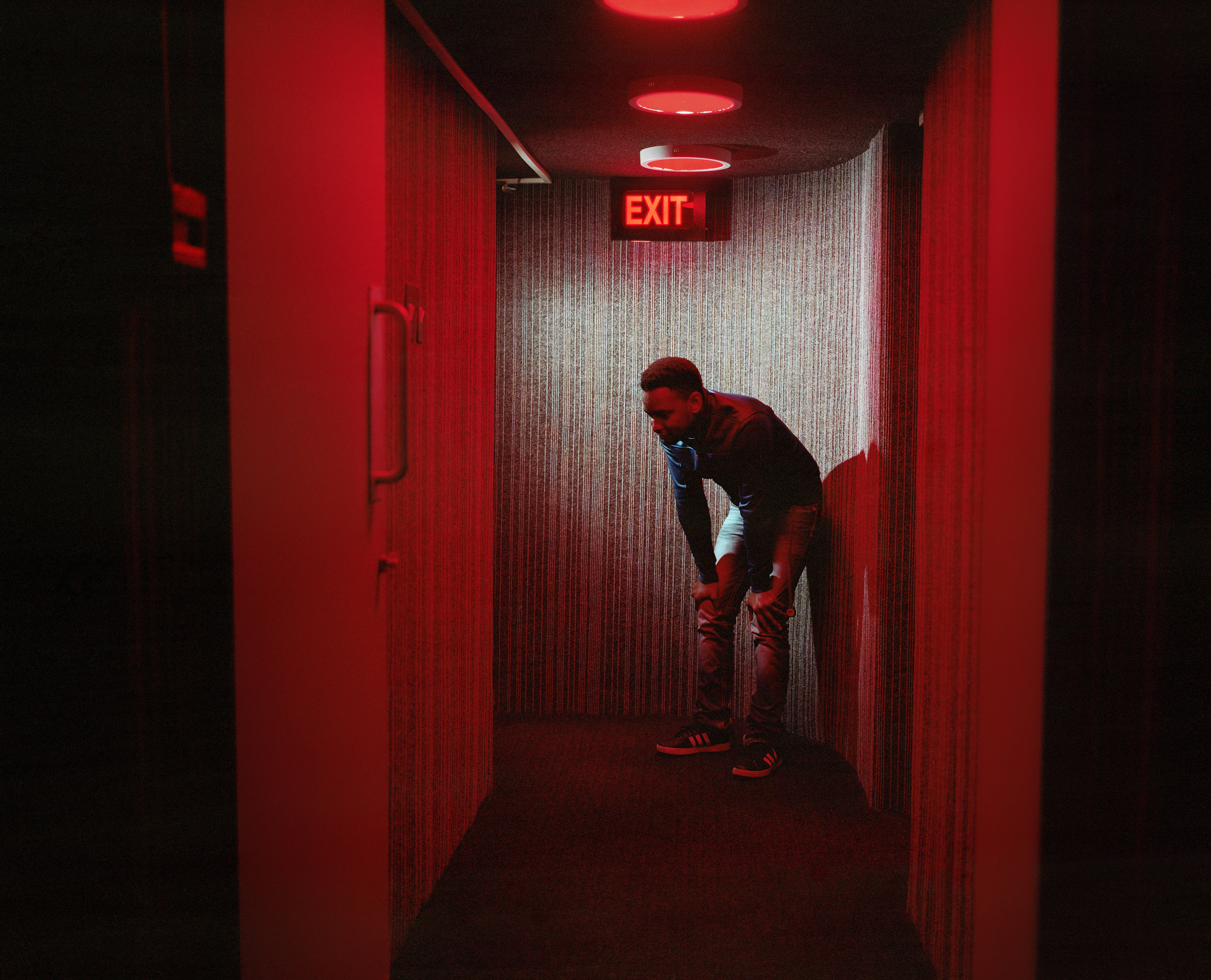
This is a transition area between Planetarium entrance and the Planetarium dome - An area where the viewers eyes are given some time to adjust to the darkness that they will be in when inside the dome.
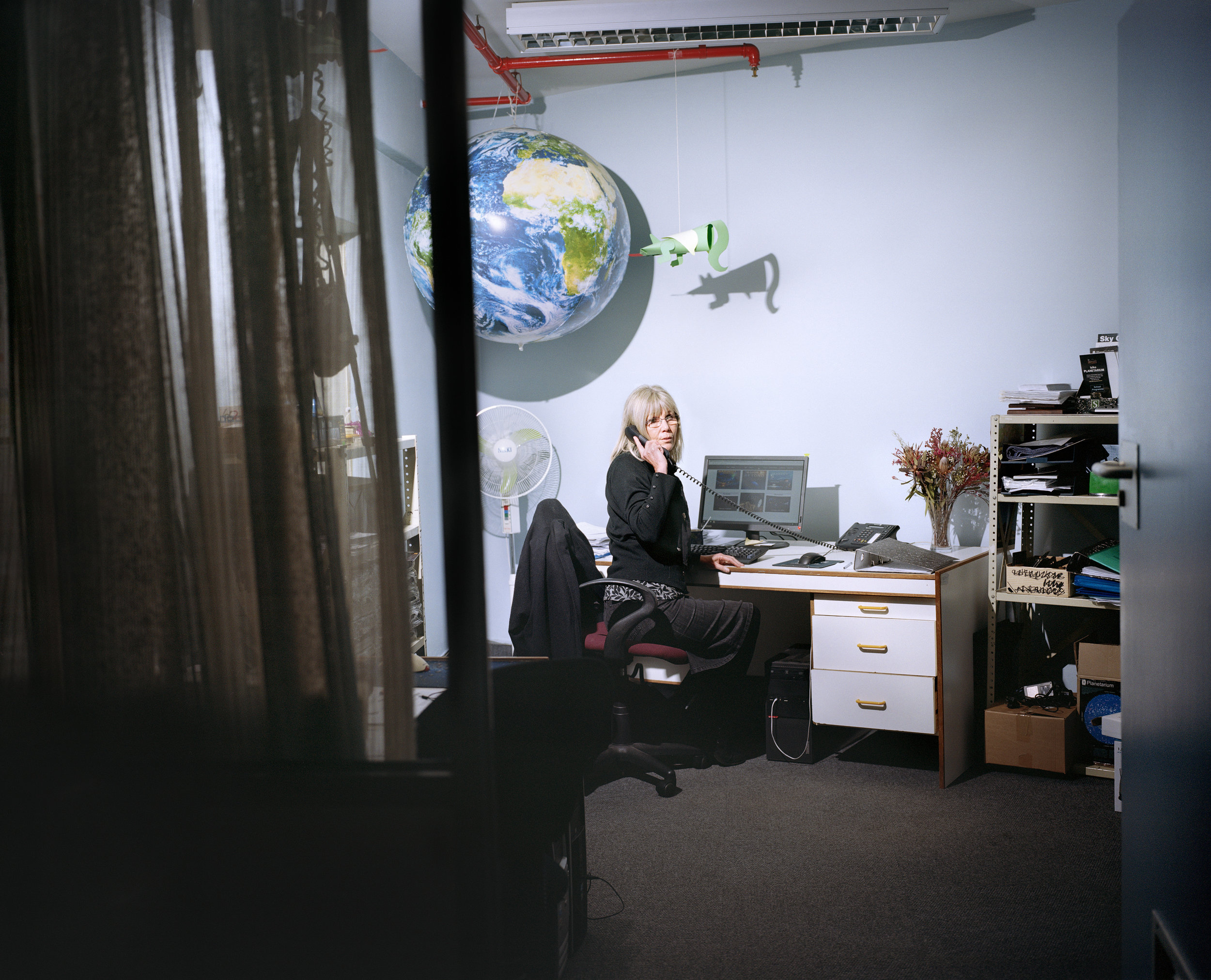
'The place where I was born influenced my life to a great extent - I was born in the Northern Cape, in a small town called Upington, where the summers would be so hot you couldn't sleep indoors; we would carry our beds outside and sleep there. That is where my love of stars started, and it kept on influencing the rest of my life - it is as if I was born to do this. I'm at my happiest when I am here and telling people what they can see up there in the night sky. When I've been away from the planetarium and I come back to it again and activate the system and see what is up there, it is like coming home. It really touches me - I remember showing children for the first time with the new system flying away from Earth, and seeing planet Earth projected on the dome, even though I knew it was just a projection - to me it was such an emotional moment, to see our planet so fragile, so beautiful, so blue, projected on the dome. I could share that moment with the children as it felt like they were with me from the responses I got. You can do so much more with the new system than the old one, although I'm still sometimes very nostalgic about the old system, how it was really a hands-on system, now you are just sitting behind the computer and pressing the buttons, but it can show you show much more and can put you right there. You feel less contained with this system, here I can fly you thought the solar system, through the galaxy, out of our galaxy and the gasps I get from people when they see our galaxy from the outside is just absolutely amazing. This is as close to real as we can take you, without putting you into space, which is of course not possible at the moment!'
Elsabé Uys, Planetarium Presenter, Iziko Planetarium, Cape Town
'Do you want to hear it? It is nothing spectacular. But you’ll get an idea of what happens during the eclipse. Maximum brightness, first contact, second contact… getting close to totality - It doesn’t go completely silent because you will always have some light. We were able to get our sensor to be sensitive enough to detect luminosity. My friends at the University of Harvard were able to achieve minus 1 lux of sensitivity, that means it is a little bit more sensitive than the human eye.'
Wanda was a post doctoral fellow at the South African Astronomical Observatory in Cape Town and currently works with the Office of Astronomy for Development(OAD) where she has led the OAD project AstroSense since April 2014. She helped develop sonification methods that allow us to listen to the stars. Her research in this field started after losing her sight as an undergraduate at the University of Puerto Rico.
These rocks contain a high percentage of iron and their dark appearance forms a truly ancient landscape. The rocks make a metal sound when played; they are referred to with different names such as ‘rock gongs’, ‘ringing rocks’ or even ‘bushman pianos’. Found in various areas around the world and Africa, tradition formed around communicating with the help of the rocks - evident by the ancient drumming marks often found on them.
'With the 1.9m we were looking at the spectra itself. Like looking at a prism, we used diffraction gratings where you could shift the light and look at different parts of the colour spectrum - from there you can tell from what stars were made of and so forth. Just doing star gazing, especially if you look at Jupiter and Saturn, it blows your mind away. If you look at Jupiter it looks like a solar system on its own. The big mother planet with a few small moons around it, and from time to time you see one of the moons disappear. Then you look at Saturn with the nice rings around it, it looks like a sombrero - that is just unbelievable.'
Francois van Wyk, Night Assistant and service observer, South African Astronomical Observatory, Sutherland.
'Meteorites or shooting stars are regarded in the Xhosa speaking community as a bad luck omen. This is because it is believed that when somebody dies they become an ancestor and the spirit of that dead person is wandering among the stars guarding us from the evil spirits. So if, perhaps, one dies as a bad person then that person would be a bad spirit or ancestor and up in the celestial sphere the good ancestors would kick out the bad ancestors - so when you see a meteor coming down you are actually seeing one of those bad ancestors being kicked out of the celestial sphere and it falls down. When you see this we say ‘let the bad luck pass us for we are not the only one who saw that’ - meaning that we associate that with bad spirit.'
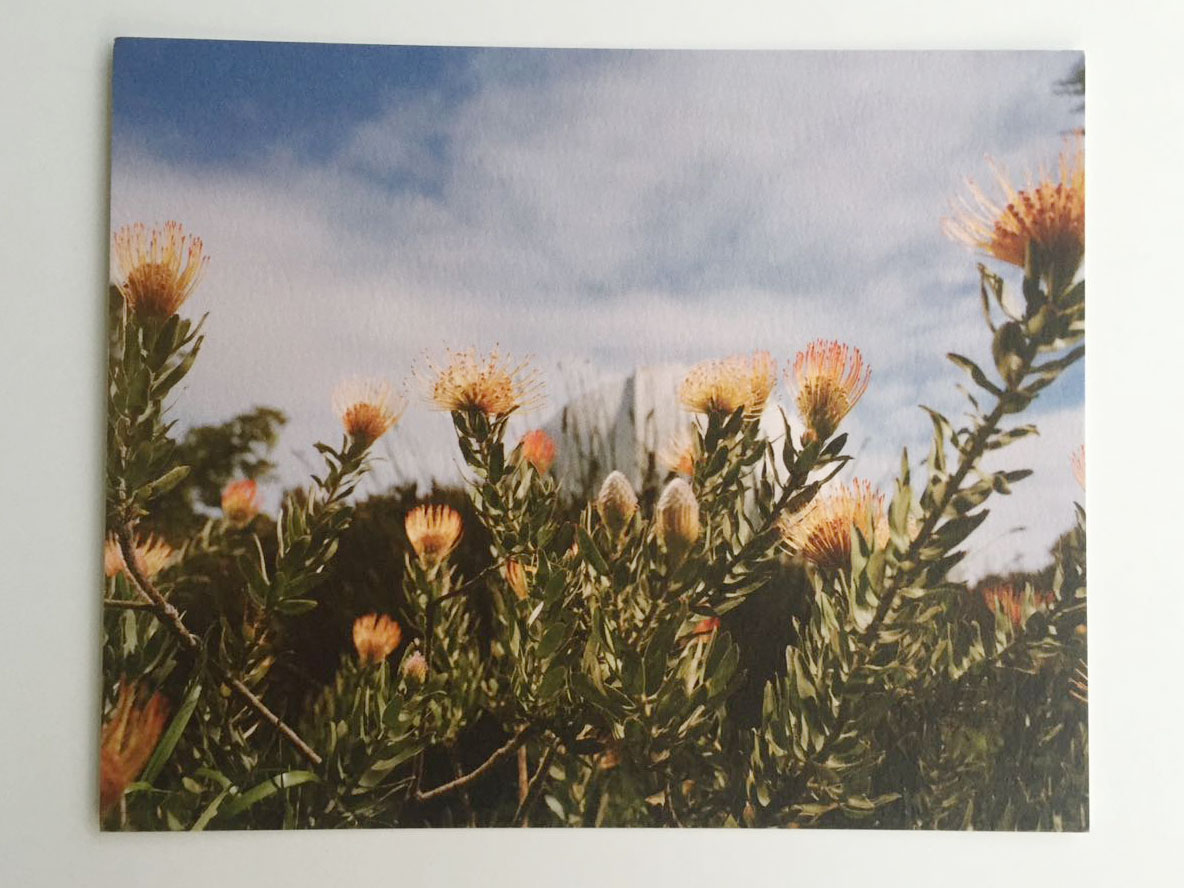
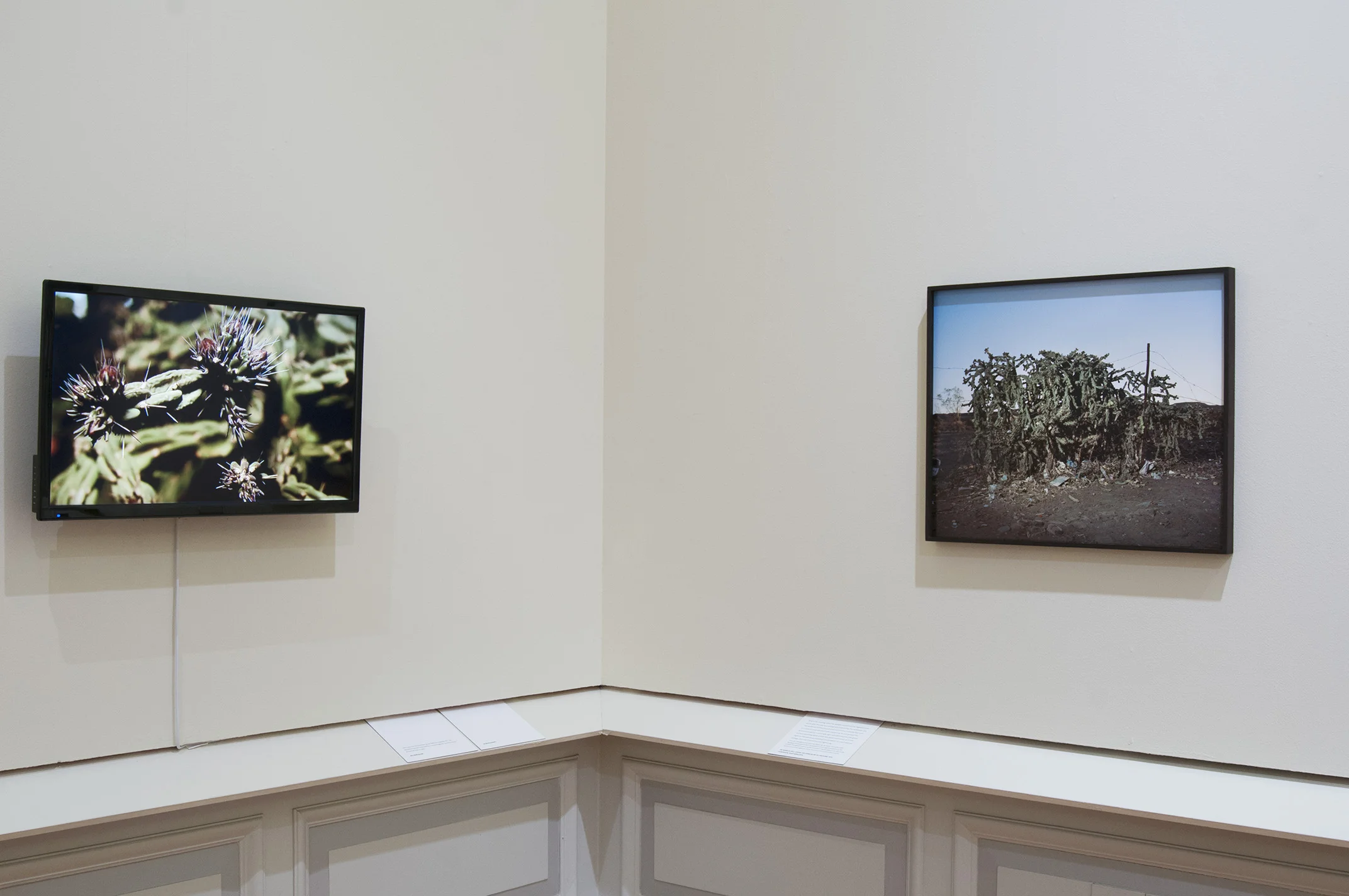
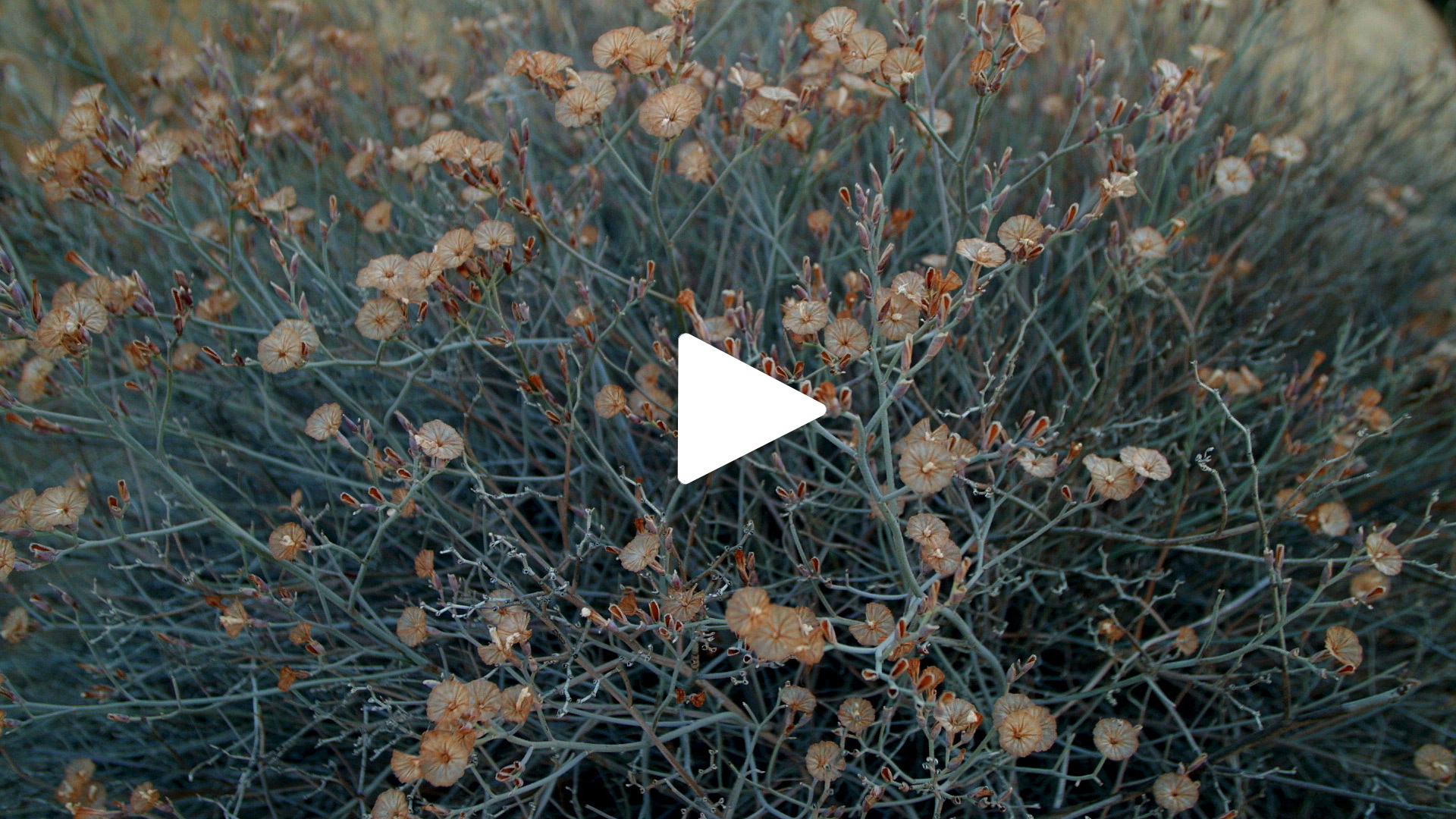
‘I’ll just tell them it is a thorny tree, it can get stuck into your clothes - you have to pull it out. It goes so deep into your skin that you need to rip it out - it is very dangerous plant. I don’t even want to get close to it and I keep my distance when I water it. It will pierce straight through your clothes into your skin - the thorns are that sharp.’ The same species of plant that was chosen for the photograph of Die Hemelblom (photograph to the right) was found growing in front of Wilhelmina Bostaander’s house in Carnarvon. Photograph inspired by Die Hemelblom, by Jan Rabie, first published 1971. The Hemelblom was sent to the earth by a concerned galactic council to ensure the survival of life on earth.
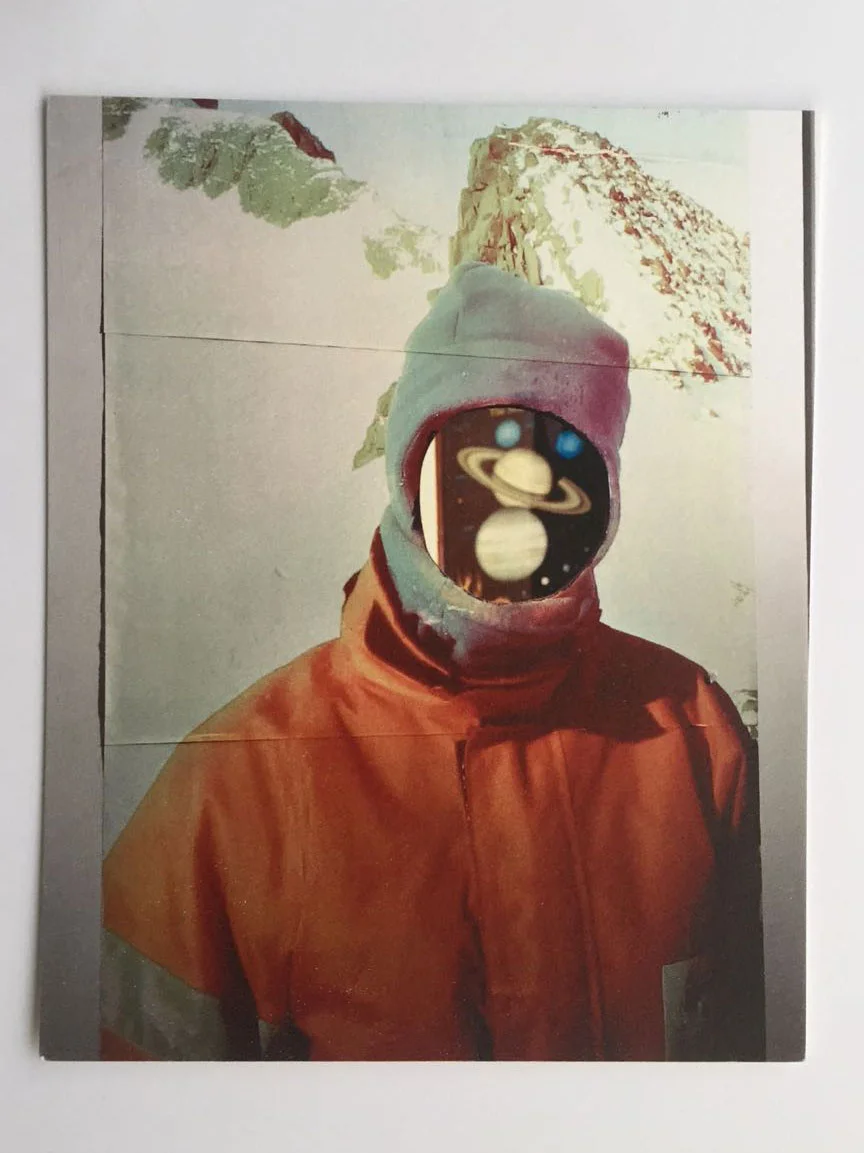
A planetary poster is visible through an educational face in the hole display at the Space Science Centre in Hermanus - South Africa's national geomagnetic research facility.
South Africa maintains a scientific base in Antartica where it is ideal to study the Southern Atlantic Magnetic Anomaly - covering an area where communication systems are more exposed and vulnerable to damages and interruptions caused by high levels of radiation from space. Together with the geomagnetic and auroral observation research done on the Antarctic, Marion and Gough Islands, SANSA Space Science promotes interest in science through science advancement programmes.
SANSA(South African National Space Agency) Space Science emerged from the original Hermanus Magnetic Observatory that was first established in 1941.
Text adapted from www.sansa.org.za.
‘Of course I hope with peoples interest we could take tours to see it properly - we have some ideas in the future to have a kind of heritage trail around the place. A lot of interesting scientific discoveries were made there - the discovery of oxygen in stars for example. At the moment there is a more modern telescope mounted on the mount, but that is not used - I would like to put the old telescope back there and restore it to the original. It should be possible. It was moved about 20 years ago but it is still in the dome actually. Of course it is heavy - we’ll need some proper tackle and things to mount it.’
Ian Glass, Professor of astronomy
'My first three years, I was working with other people as I was undergoing training. From there on, most of the time I was on my own. Sometimes for 14 hours in winter, just with a CD player, my night lunch and my coffee. Then it is up to you to make all the decisions. You have just got to make sure you stay awake and alert. Otherwise you can screw up big time. I did fall asleep, but the thing is, if you feel you are tired it is best to close the dome, switch everything off and sit and sleep. If you leave things on and you fall asleep then you are in trouble.’
Francois van Wyk, Night Assistant and service observer, South African Astronomical Observatory, Sutherland.
SALT (Southern African Large Telescope) at the South African Astronomical Observatory, just outside Sutherland in the Northern Cape. It is one of the largest optical telescopes in the world - so powerful and sensitive that it could spot a candle flame on the moon.
‘The half blood is not accepted by anyone, he is not ethnic enough for his own group and not good enough for the group he is descended from. So both groups reject him, but he posesses the skills and knowledge of both groups - the strong characteristics of both groups is combined within him. Even though he is initially rejected by the modern group and the historical native group, at the end of the day he unites them - he is the glue that keeps them together. He is the connection or the missing link between them and the two groups then fight together against what you can call the evil side - the bad guys in the story. With him as the leader figure. In the beginning the natives from the planet Kazdan, the Hunters didn't trust the Neanites who were technologically advanced - almost seen as gods. Like it was in the past when the white man landed in the Cape - everybody thought it was amazing and at the end of the day it wasn't that amazing and there is a golden middle groud to be followed and somebody has to take the lead - that is the half blood that brings the groups together. That is the initiating concept of my sci-fi story.’
Nico Smit, Sci-Fi Writer, Clanwilliam
'For real, that is not a shadow, but an upright being squeezed up against the edge. Kind of like a human form with two arms and legs, a narrow, oval face framed by a cap looking like a bare skull, clothed in a blue overall that they only had a glimpse of previously. Dead quiet. Francois lowers the torch, lifts it again. One thing is for sure: this being is just as afraid as they are.'
From Die Hemelblom (The Heavenly Flower) by Jan Rabie, 2nd edition 1974, Tafelberg, first published 1971. Translated from the original Afrikaans by Nic Grobler.
The first encounter with Marwa, the main alien character in Die Hemelblom takes place in a collapsed cave near the Cederberg - she takes hands with the humans as they search for the a way out together.
‘I enjoyed the scientific work, especially solving problems and understanding the physics of the stars, so doing something like this is a kind of motivation for other people to become interested in astronomy and until you studied physics and astronomy you don’t really know what is going on in the stars and you don’t see what professional astronomers are interested in. There are many things happening in our own galaxy and in our own solar system and of course with the space age we know a lot more now about planets and asteroids and many things. So even quite nearby objects turned out to be more interesting than people realised in the past. I studied the heat radiation from stars, with infra-red light. Usually stars that are forming or stars that are dying have a lot of dust around them and this shows up very strongly in the infra-red, so I studied basically variable stars that show up brightly in the infra-red and I studied certain types of galaxies which have active centers, the nuclei we call them - and Quasars. So you think of stars, but dust and gas are also very important parts of the galaxies in the sky.’
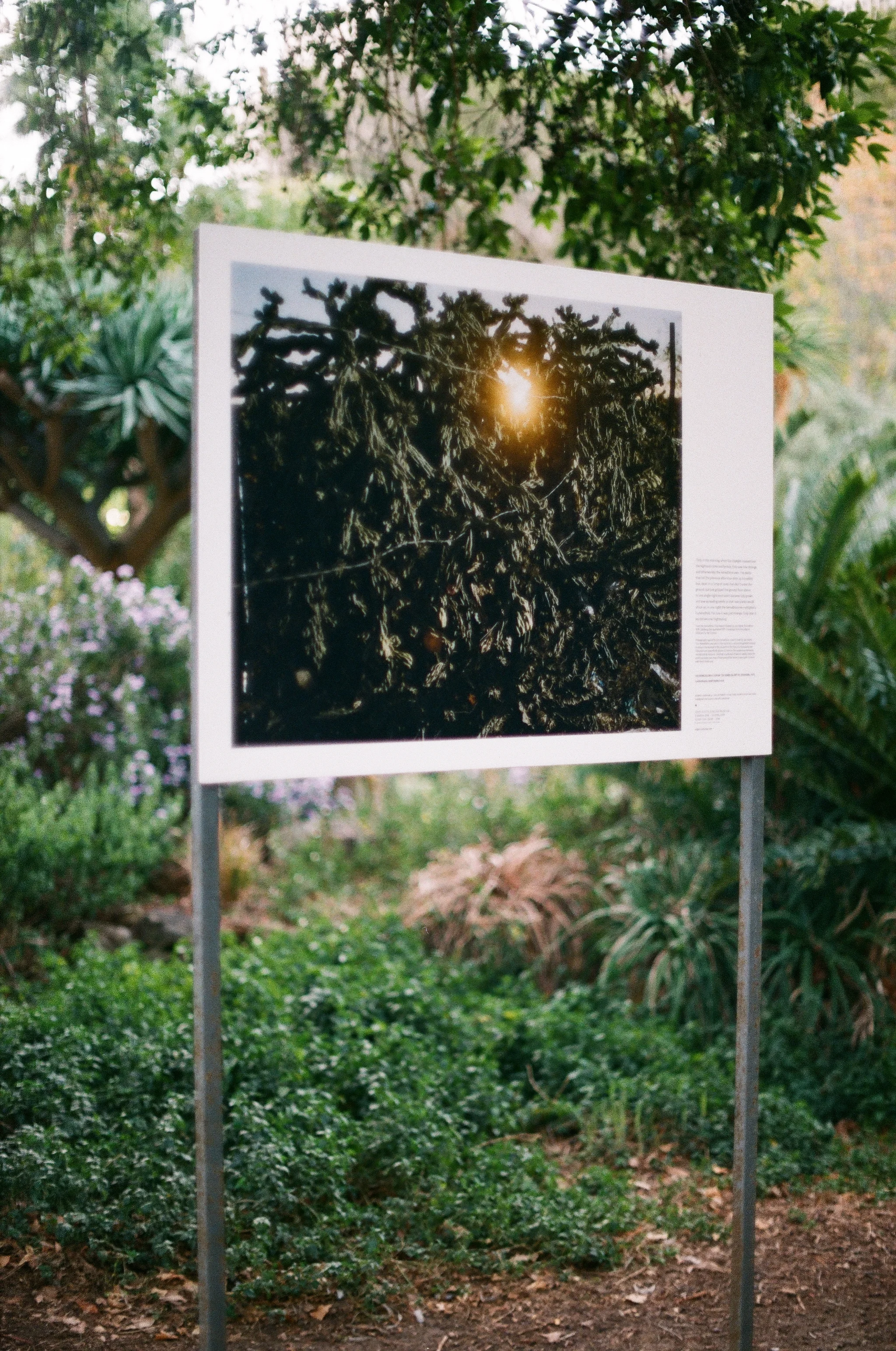
'Only in the morning, when the daylight crossed over the highland rocks and fynbos, they saw how strange and otherworldly the hemelblom was. The seeds that fell the previous afternoon shot up incredibly fast, each on a lump of roots that didn't enter the ground, but just gripped the ground from above. In one single night each plant became fully grown and was spreading seeds so that new plants would shoot up. In one night the hemelblomme multiplied a hundredfold. For now it was just strange. Only later it would become frightening.'
From Die Hemelblom (The Heavenly Flower) by Jan Rabie, 2nd edition 1974, Tafelberg, first published 1971. Translated from the original Afrikaans by Nic Grobler.
Photograph inspired by Die Hemelblom (The Heavenly Flower), an Afrikaans sci-fi novel by Jan Rabie.
The Hemelblom was sent to the earth by a concerned galactic council to ensure the survival of life on earth in the face of a new world war. The plant was specifically grown to remove the poisonous elements introduced by humans - feeding on pollution it would rapidly cover the earth and wipe out most of humankind but leave a new earth covered with fresh fertile soil.
'Are we alone, I don’t know - the thing is we will probably never know. If we find a civilization that can signal to us, we’ve got to be able to signal to them. If they are a 100 light years away we are talking about a 100 years between every communication, and by then the other one may have died out or they may have not reached the communications technology or we may have blown ourselves up enough to have to start all over again. So we will probably not communicate with anyone out there - not in our lifetime. But there is probably someone. We are so proud that we call them aliens - we may be the aliens. Who knows.'
Chris Forder. Amateur Telescope builder.
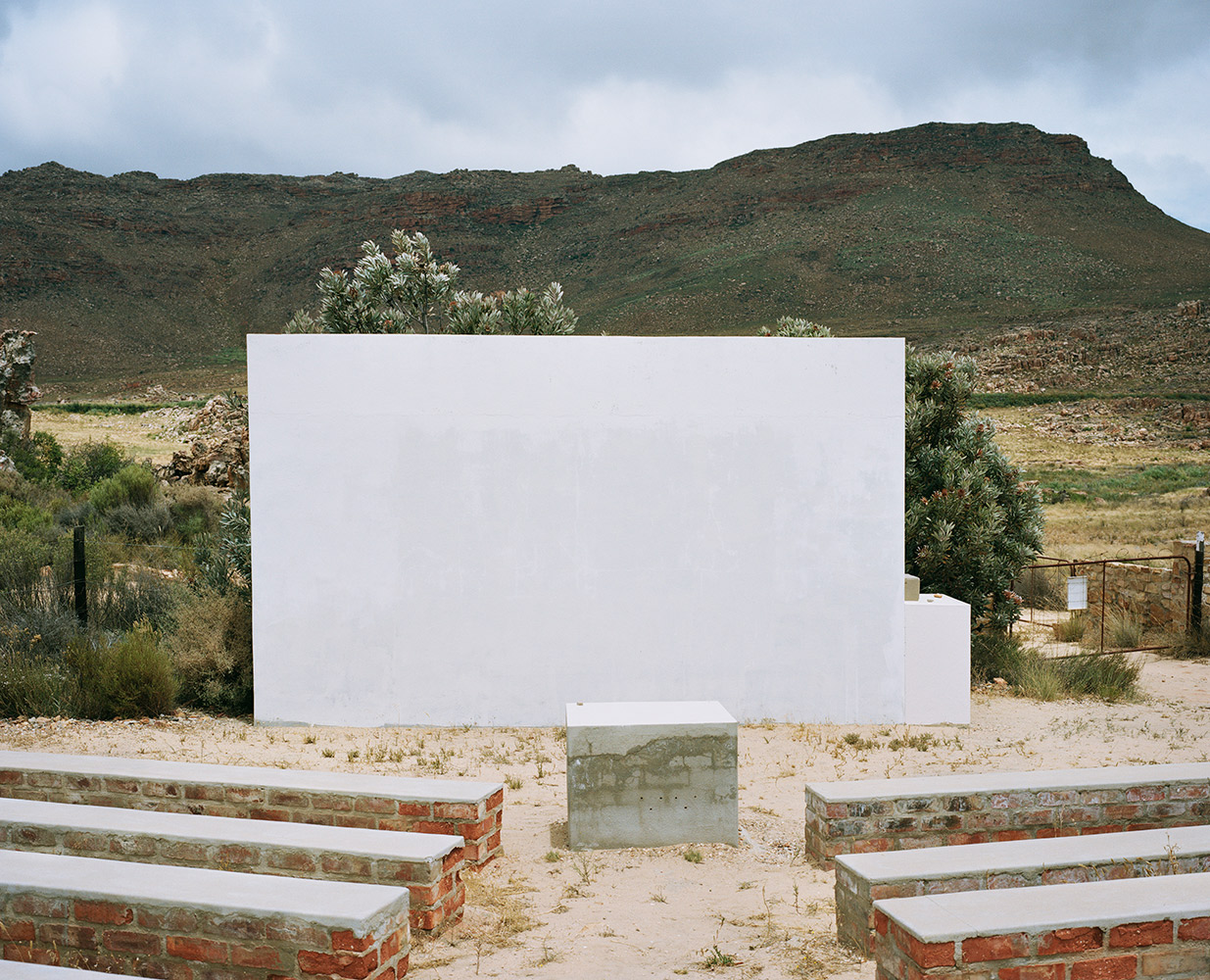
'We all sat down in this amphitheatre - everyone so excited. Waiting for it to start, and then every now and then a car would arrive in the parking lot and its lights would shine onto the screen and then everyone would freak out a bit. This guy gave a presentation, using like Hubble telescope photographs, each and every photo - incredibly impressive full multicoloured images. This all whilst telling us about the telescopes they themselves have built and that we will be able to see Jupiter with them after the presentation. When we eventually went to look through the telescopes - it was all monochrome tiny little things, no multicolored Hubble stuff. Anyway, it was so great though seeing these old guys, listening to Led Zeppelin, who go up there every two weeks, observing through the night. It’s their thing, it is like playing golf to them'
Dennis Williams, visitor to Cederberg Astronomical Observatory.
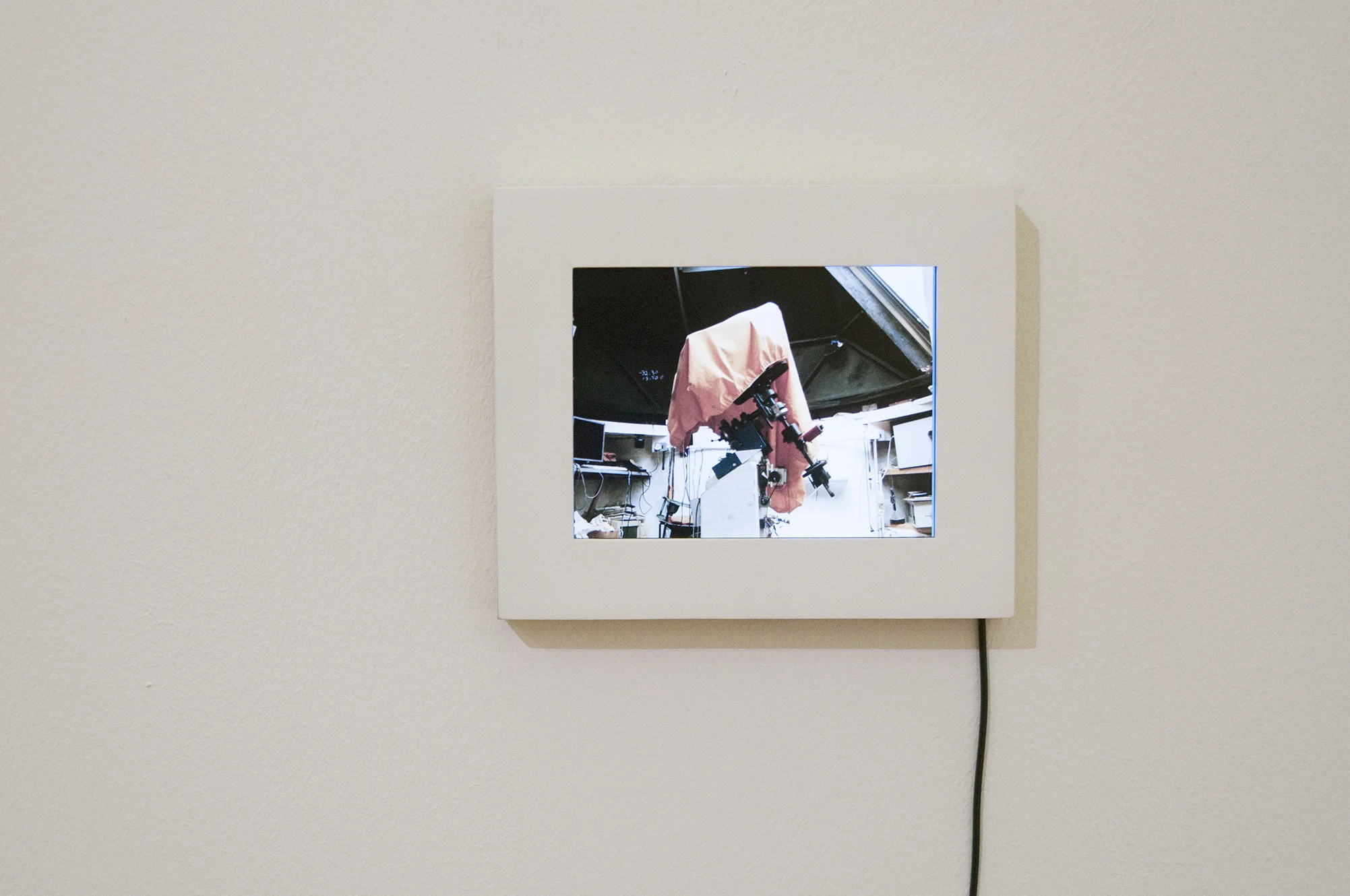
McClean telescope installed in 1897 at the South African Astronomical Observatory in Cape Town.
‘That was the most beautiful to me, when there is a shooting star, I always believed you could make wish - for good luck. Then I asked some questions and they answered, ‘o, no - when there is a shooting star, it means it is dead and it is going to fall’ and there where it falls, everything must just pray and ask ‘God don’t let it fall on a house, don’t let it fall on a person’ - because it can burn and kill, and you don’t know if it has fire inside, you don’t know if it has hail inside or even iron inside.’
Anna Skippers, Kamammas Community centre coordinator, Sutherland, Northern Cape.
Anna lives in Sutherland, close to the largest single optical telescope in the Southern Hemisphere.
* Makes me think of the heap of equipment hey see when looking back in time in Swart ster oor die Karoo. Perhaps we can include a small quote from the book.
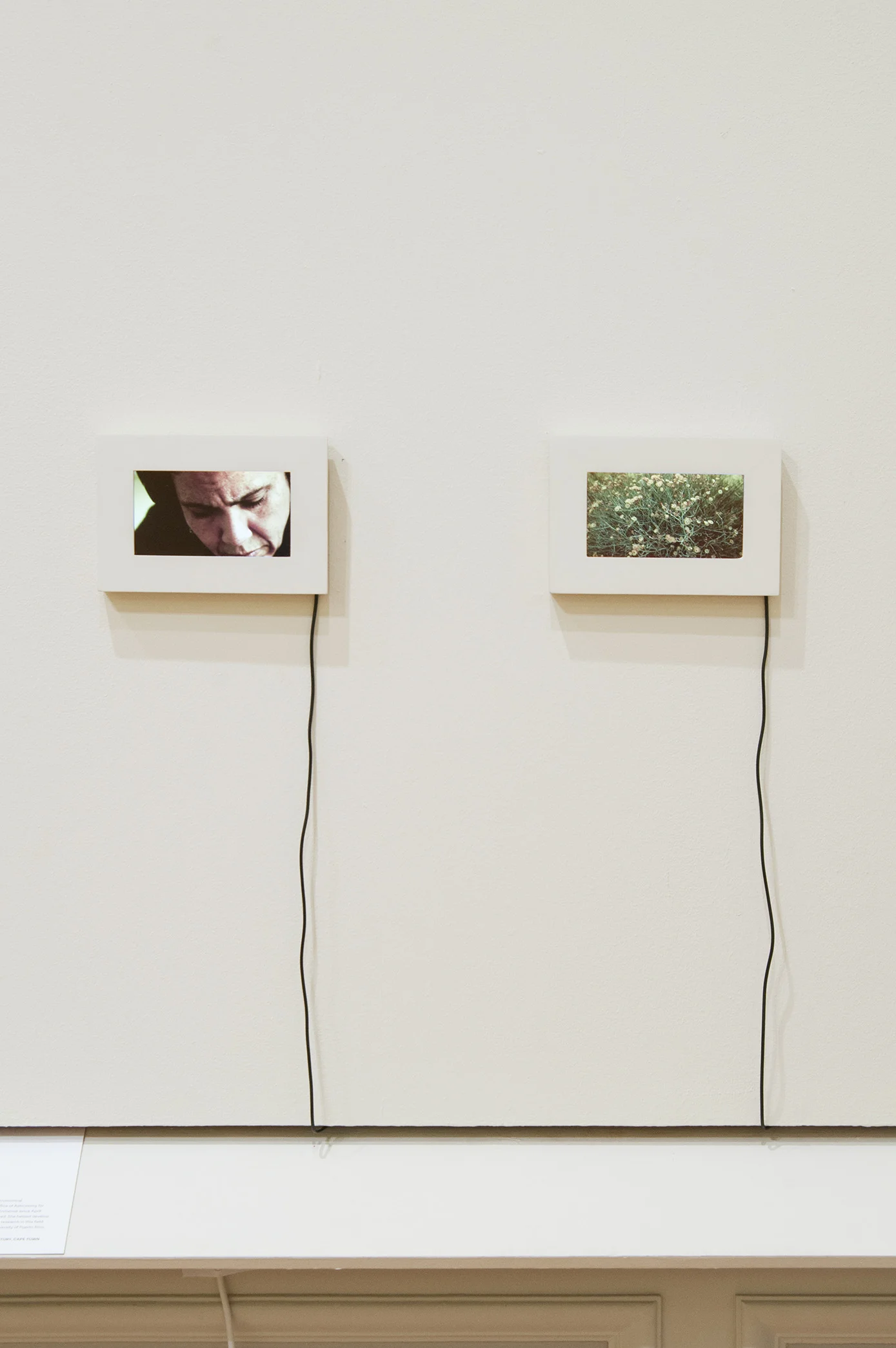
VIDEO INSTALLATION, VIDEO INSIDE GAIASPHERE, 3 40" TV SCREENS AND 3-4 15" PICTURE FRAME TYPE SCREENS
'For real, that is not a shadow, but an upright being squeezed up against the edge. Kind of like a human form with two arms and legs, a narrow, oval face framed by a cap looking like a bare skull, clothed in a blue overall that they only had a glimpse of previously. Dead quiet. Francois lowers the torch, lifts it again. One thing is for sure: this being is just as afraid as they are.'
From Die Hemelblom (The Heavenly Flower) by Jan Rabie, 2nd edition 1974, Tafelberg, first published 1971. Translated from the original Afrikaans by Nic Grobler.
The first encounter with Marwa, the main alien character in Die Hemelblom takes place in a collapsed cave near the Cederberg - she hold hands with the humans to make it out alive.
'We got music going - we try to keep it to calm music, so that we are not too excited. If you get too excited then things start going wrong and you start doing stupid things. You must just keep calm the whole time while you are imaging. After all, the stars will wait - if you don’t get them tonight, you can get them tomorrow night. Time is nothing to them, time is everything to us. '
Chris Forder. Amateur Telescope builder.
'It was formed around the same time as our Sun and the Earth and after a leisurely tour of the Solar System as the centre of an asteroid, it came crashing down into southern Africa as the Gibeon Meteorite.
The Nama people used smaller bits of the meteorite for tools and countless chunks remained scattered over a large area. In 1836 Englishman J. E. Alexander collected samples and sent them to London. John Herschel confirmed they were indeed not of this planet.' *
Anna lives in Sutherland, close to the largest single optical telescope in the Southern Hemisphere.
'Only in the morning, when the daylight crossed over the highland rocks and fynbos, they saw how strange and otherworldly the hemelblom was. The seeds that fell the previous afternoon shot up incredibly fast, each on a lump of roots that didn't enter the ground, but just gripped the ground from above. In one single night each plant became fully grown and was spreading seeds so that new plants would shoot up. In one night the hemelblomme multiplied a hundredfold. For now it was just strange. Only later it would become frightening.'
From Die Hemelblom (The Heavenly Flower) by Jan Rabie, 2nd edition 1974, Tafelberg, first published 1971. Translated from the original Afrikaans by Nic Grobler.
Video inspired by Die Hemelblom (The Heavenly Flower), an Afrikaans sci-fi novel by Jan Rabie.
The Hemelblom was sent to the earth by a concerned galactic council to ensure the survival of life on earth in the face of a new world war. The plant was specifically grown to remove the poisonous elements introduced by humans - feeding on pollution it would rapidly cover the earth and wipe out most of humankind but leave a new earth covered with fresh fertile soil.
'To whom shall I dedicate this book? It is about a being who is not human, who is higher than man - an unattainable superior.
I think I will go to the opposite - and then I will not have to look very far. I lost a friend a long time ago - a friend that I loved and who loved me. I will never see him again forever; but forever I will never forget him. Now, after all these years, there is not a day that passes without his image coming before me and I'm grieving about him. To him I was the higher being - a Loeloeraai of a higher existence. To me he was the ultimate perfection I found on earth, of love and faithfulness and virtue. And I lost him, and I miss him dearly. . .
I dedicate this work:
To the memory of
MY FRIEND AND DOG, JAKHALS’
Translated from original Afrikaans by Nic Grobler, Loeloeraai, CJ Langenhoven, 4th Edition 1929, First published 1923.
Video inspired by the dedication of the 1923 Sci-fi novel, Loeloeraai by CJ Langenhoven.
"THE ATTEMPT" INSTALLATION OF PHOTOGRAPHIC PRINTS (15 x 12cm), COPIES, NATURAL ELEMENTS
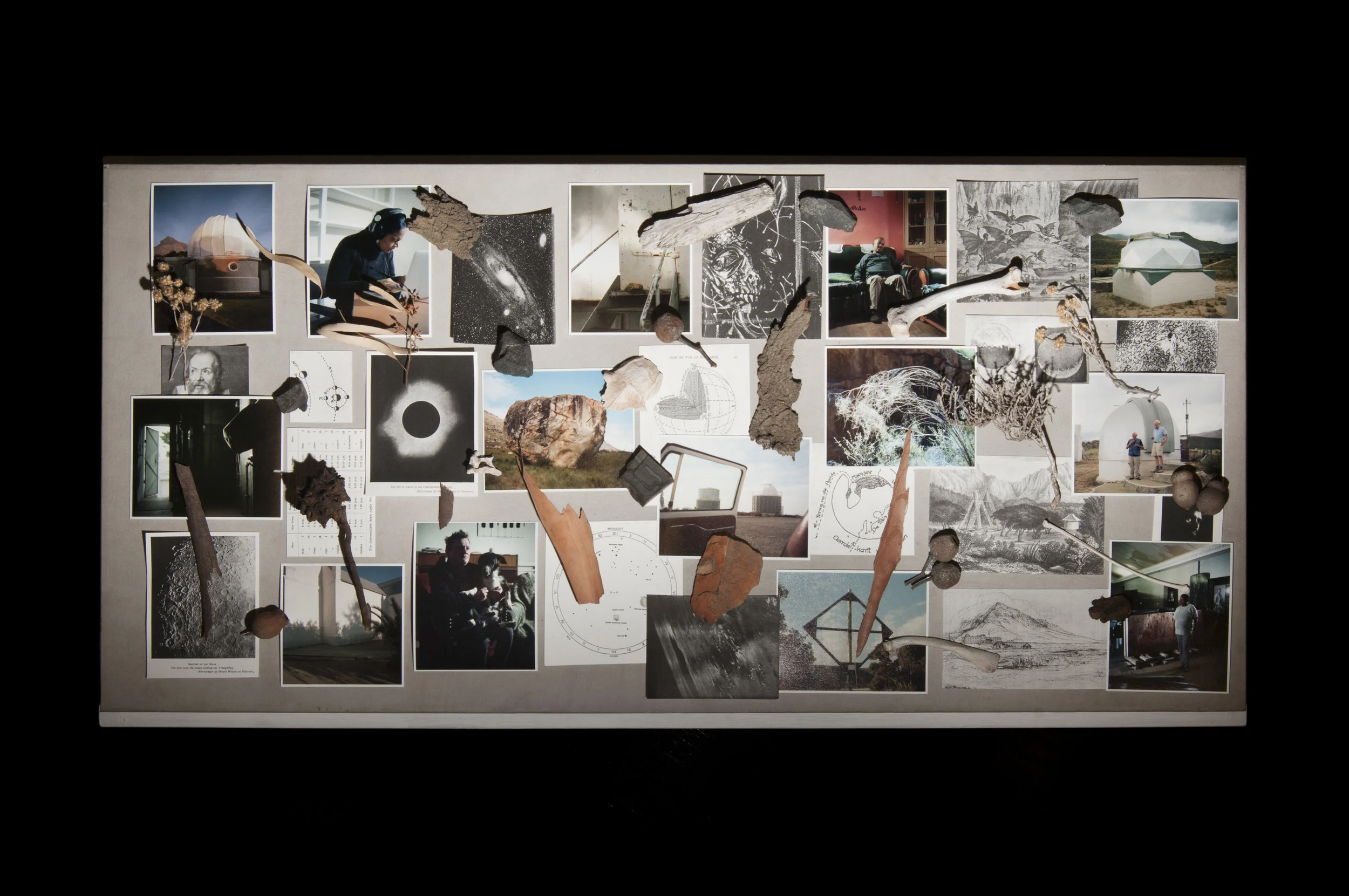
CHAPTER ONE (OUTDOOR PART) AT COMPANY'S GARDEN
‘What makes this system so powerful is that you can leave the earth - you are not stuck on the earth anymore. Traditional planetarium shows are stuck on the earth looking up at the night sky, now we can fly away from the earth and travel through the universe, moving out into space - right back to the beginning. We don’t actually have data sets that go that far back, but be can get really close, looking at some of the galaxies billions of light years away from us and, of course, when you are looking at those galaxies you are looking back in time - into the past. This is strange because we are looking at objects develop, seeing them as they were a very long time ago.’
‘I enjoyed the scientific work, especially solving problems and understanding the physics of the stars, so doing something like this is a kind of motivation for other people to become interested in astronomy and until you study physics and astronomy, you don’t really know what is going on in the stars and you don’t see what professional astronomers are interested in. There are many things happening in our own galaxy and in our own solar system and of course with the space age we know a lot more now about planets and asteroids and many things. So even quite nearby objects turned out to be more interesting than people realised in the past. I studied the heat radiation from stars, with infra-red light. Usually stars that are forming or stars that are dying have a lot of dust around them and this shows up very strongly in the infra-red, so I studied basically variable stars that show up brightly in the infra-red and I studied certain types of galaxies which have active centers, the nuclei we call them - and quasars. So you think of stars, but dust and gas are also very important parts of the galaxies in the sky.’
‘Some people have this strange notion that there is a clash between religion and science. Especially when they come to a poor congregation, where the majority are poor people, they will think that they are perhaps creationist type of people - who reject science per se. That is not even close to the truth. In fact, I think we love science, we love to know more. We may have a certain interpretation of the wonders of creation, we believe in a creator, we believe that God not only created everything but that we are part of that creation and we want to really dispel the notion of science versus religion as always clashing. The Bible was never written with the intention of writing up a science handbook.’
Dr. Isak Potgieter, Pastor, United Reformed Church, Carnarvon
'Only in the morning, when the daylight crossed over the highland rocks and fynbos, they saw how strange and otherworldly the hemelblom was. The seeds that fell the previous afternoon shot up incredibly fast, each on a lump of roots that didn't enter the ground, but just gripped the ground from above. In one single night each plant became fully grown and was spreading seeds so that new plants would shoot up. In one night the hemelblomme multiplied a hundredfold. For now it was just strange. Only later it would become frightening.'
From Die Hemelblom (The Heaven Flower) by Jan Rabie, 2nd edition 1974, Tafelberg, first published 1971. Translated from the original Afrikaans by Nic Grobler.
Photographed inspired by Die Hemelblom, Jan Rabie. The Hemelblom was sent to the earth by a concerned galactic council to ensure the survival of life on earth in the face of a new world war. The plant was specifically grown to remove the poisonous elements introduced by humans - feeding on pollution it would rapidly cover the earth and wipe out most of humankind but leave a new earth covered with fresh fertile soil.
'To whom shall I dedicate this book? It is about a being who is not human, who is higher than man - an unattainable superior.
I think I will go to the opposite - and then I will not have to look very far. I lost a friend a long time ago - a friend that I loved and who loved me. I will never see him again forever; but forever I will never forget him. Now, after all these years, there is not a day that passes without his image coming before me and I'm grieving about him. To him I was the higher being - a Loeloeraai of a higher existence. To me he was the ultimate perfection I found on earth, of love and faithfulness and virtue. And I lost him, and I miss him dearly. . .
I dedicate this work:
To the memory of
MY FRIEND AND DOG, JAKHALS’
From the dedication of Loeloeraai, CJ Langenhoven, 4th Edition 1929, First published 1923. Translated from original Afrikaans by Nic Grobler.
Photograph inspired by Loeloeraai, CJ Langenhoven. Loeloeraai is a visitor from Venus, who spends about two weeks with a family in Oudtshoorn. They end up going on a small trip to the moon before Loeloeraai returns to Venus.
This building houses the Gill Reversible Transit Circle, built in 1905 to measure the position of stars as they pass the north-south meridian and to check the accuracy of clocks. It was also used to contribute to the Catalogue of Fundamental Stars (Fundamental Katalog FK4), and was in use until around 1980 - after which the use of space satellites became the norm in the 1990s. The building is in need of repair and apparently one of its chimneys is housing a bee hive.
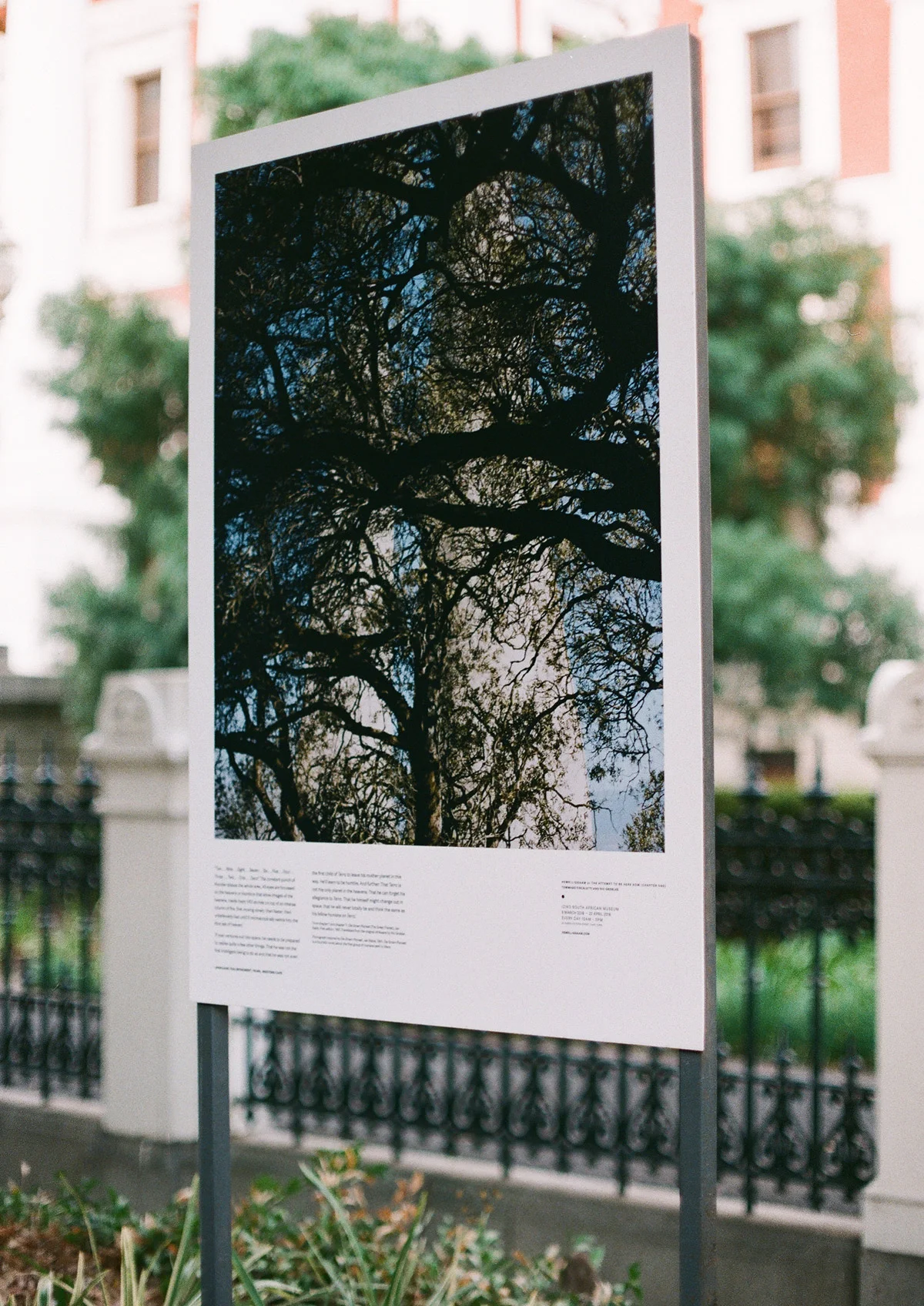
'"Ten . . . Nine . . . Eight . . . Seven . . . Six . . . Five . . . Four . . . Three . . . Two . . . One . . . Zero!"
The constant punch of thunder shakes the whole area. All eyes are focussed on the heavens or monitors that show images of the heavens. Inside them VR3 shrinks on top of an intense column of fire, first moving slowly, then faster, then unbelievably fast until it microscopically swims into the blue sea of heaven.'
'If man ventures out into space, he needs to be prepared to realise quite a few other things. That he was not the first intelligent being to do so and that he was not even the first child of Terra to leave his mother planet in this way. He'll learn to be humble. And further: That Terra is not the only planet in the heavens. That he can forget his allegiance to Terra. That he himself might change out in space, that he will never totally be and think the same as his fellow humans on Terra.'
From chapter 1 and chapter 11, Die Groen Planeet (The Green Planet), Jan Rabie, First edition, 1961. Translated from the original Afrikaans by Nic Grobler.
Photograph inspired by Die Groen Planeet, Jan Rabie, 1961.
Ofentse Letebele is part of the team working to translate some of the old Planetarium shows to the new Digital Dome system.
View of the McClean telescope dome, South African Astronomical Observatory. The Observatory garden contains many beautiful flowers and plants including rare species, having become somewhat of a sanctuary in the area. Flowers in the foreground are Leucospermum cordifolium - Pincushion, Bobbejaanklou, Luisiesboom, Luisiesbos.
'Meteorites or shooting stars are regarded in the Xhosa speaking community as a bad luck omen. This is because it is believed that when somebody dies they become an ancestor and the spirit of that dead person is wandering among the stars guarding us from the evil spirits. So if, perhaps, one dies as a bad person then that person would be a bad spirit or ancestor and up in the celestial sphere the good ancestors would kick out the bad ancestors - so when you see a meteor coming down you are actually seeing one of those bad ancestors being kicked out of the celestial sphere and it falls down. When you see this we say ‘let the bad luck pass us for we are not the only one who saw that’ - meaning that we associate that with bad spirit.'
'With the 1.9m we were looking at the spectra itself. Like looking at a prism, we used diffraction gratings where you could shift the light and look at different parts of the color spectrum - from there you can tell from what stars were made of and so forth. Just doing star gazing, especially if you look at Jupiter and Saturn, it blows your mind away. If you look at Jupiter it looks like a solar system on its own. The big mother planet with a few small moons around it, and from time to time you see one of the moons disappear. Then you look at Saturn with the nice rings around it, it looks like a sombrero - that is just unbelievable. My first three years I was working with other people, as I was undergoing training. From there on most of the time I was on my own. Sometimes for 14 hours in winter, just with a CD player, my night lunch and my coffee. Then it is up to you to make all the decisions. You just got to make sure you stay awake and alert. Otherwise you can screw up big time. I did fall asleep, but the thing is, if you feel you are tired it is best to close the dome, switch everything off and sit and sleep. If you leave things on and you fall asleep then you are in trouble.’
Francois van Wyk, Night Assistant and service observer, South African Astronomical Observatory, Sutherland.
'My first three years, I was working with other people as I was undergoing training. From there on, most of the time I was on my own. Sometimes for 14 hours in winter, just with a CD player, my night lunch and my coffee. Then it is up to you to make all the decisions. You have just got to make sure you stay awake and alert. Otherwise you can screw up big time. I did fall asleep, but the thing is, if you feel you are tired it is best to close the dome, switch everything off and sit and sleep. If you leave things on and you fall asleep then you are in trouble.’
Francois van Wyk, Night Assistant and service observer, South African Astronomical Observatory, Sutherland.
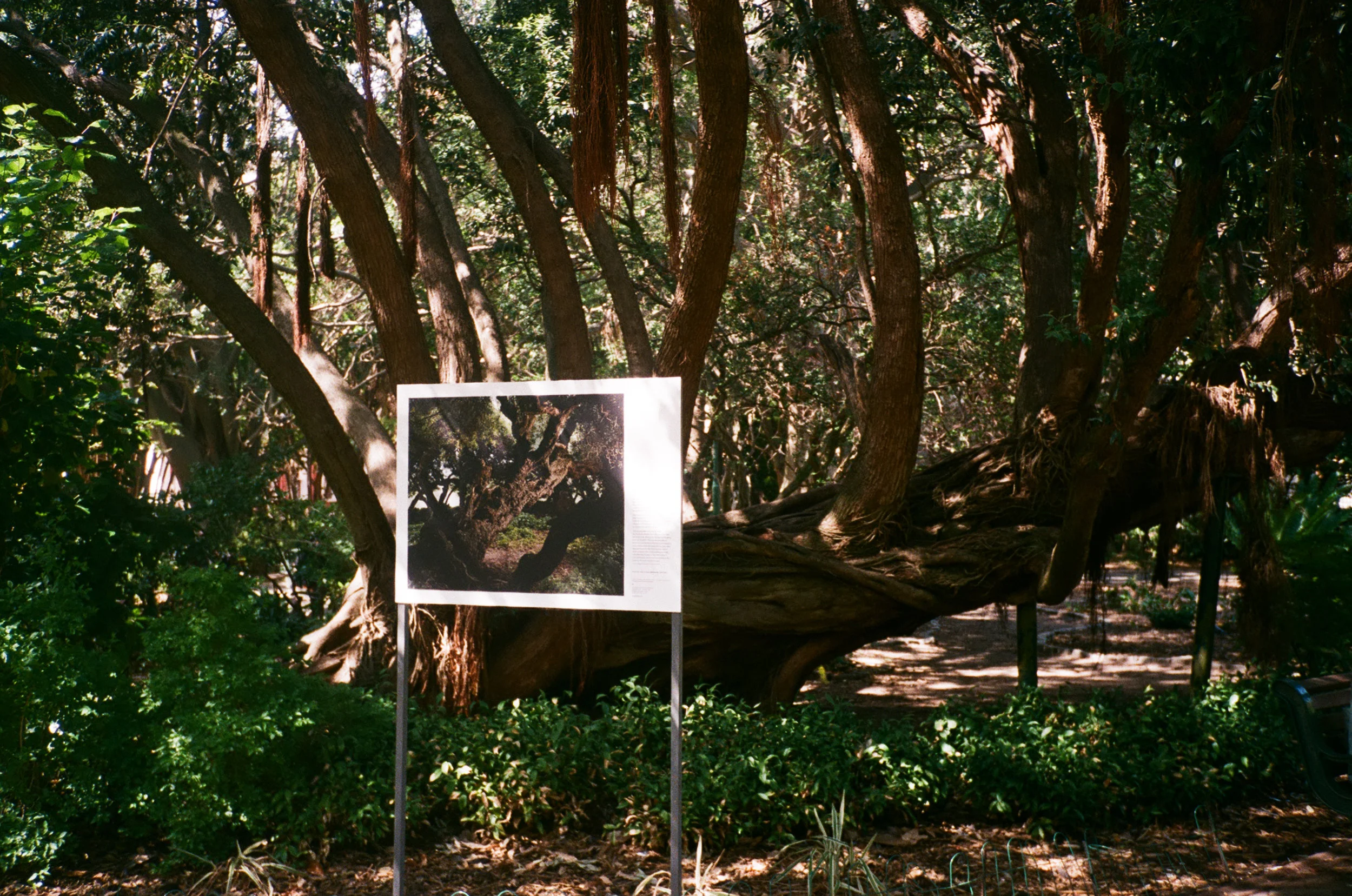
The inside area of the tree revealed that although there were numerous trunks, it seemed to be one organism, with the oldest, thickest trunk appearing to have fallen over many years ago - some of its branches entering into the ground and then growing up out of the ground again.
These trees are known for being salt, wind and fire resistant and are originally from Australia. They are popular in coastal gardens but are invading coastal fynbos, dunes and river valleys as well as being poisonous to mammals.
This ancient animal like tree can be found in a clearing adjacent to the South African Astronomical Observatory buildings - a site that was known, in the early years of the observatory as a place surrounded by marshes and covered in snakes.
'Only one spot seemed to meet all these requirements, a low hill a few miles out on the Flats from Devil's Peak which gloried the name of Slangkop, meaning "snakehill". The name was accurate, as several astronomers would later testify in unequivocal terms. Additionally it was almost devoid of soil, while being surrounded by extensive marshes, down to which a variety of wild animals would occasionally make their way. For years, in fact, there existed a body of folk-lore on the conduct of astonomy in the presence of various unsavoury beasts.'
From The Whisper & the Vision, Donald Fernie, 1976.
'Then you look at Saturn with the nice rings around it, it looks like a sombrero - that is just unbelievable. On the real astronomy side I’ve observed stars with are called roAp stars, it is short for Rapidly oscillating peculiar A stars. These are really peculiar. Those stars oscillate in a short time scale, like 8 minutes. What happens is the stars sort of blows up and gets bigger and fainter, then contracts and gets warmer. That is what you see. My first three years I was working with other people, as I was undergoing training. From there on most of the time I was on my own. Sometimes for 14 hours in winter, just with a CD player, my night lunch and my coffee. Then it is up to you to make all the decisions. You just got to make sure you stay awake and alert. Otherwise you can screw up big time. I did fall asleep, but the thing is, if you feel you are tired it is best to close the dome, switch everything off and sit and sleep. If you leave things on and you fall asleep then you are in trouble.’ - Francois van Wyk, Night Assistant and service observer, Sutherland.
Elise lives in Sutherland, home to the Southern African Large Telescope (SALT) - the largest optical telescope in the Southern Hemisphere.
‘If you consider there are between 10 and 20 times as many galaxies outside ours as there are stars in our galaxy - and we have maybe 200 billion stars, so multiply that between 10 and 20 and that is the number of galaxies, and each of those may have 200 billion stars. So we are pretty insignificant. If you go and look at a piece of sand outside. That is how insignificant we are. We think we are important but we are not.’
Chris Forder, amateur telescope builder, Cederberg Astronomical Observatory partner.
‘Are we alone, I don’t know - the thing is, we will probably never know. If we find a civilization that can signal to us we’ve got to be able to signal to them. If they are a 100 light years away we are talking about a 100 years between every communication, and by then the other one may have died out or they may have not reached the communications technology or we may have blown ourselves up enough to have to start all over again. So we will probably not communicate with anyone out there - not in our lifetime. But there is probably someone. We are so proud that we call them aliens - we may be the aliens. Who knows.’
Chris Forder, amateur telescope builder, Cederberg Astronomical Observatory partner.
This photograph was taken during the night of 14 November 2016, with the biggest supermoon since 1948. When a full moon takes place when the Moon is near its closest approach to Earth, it is called a Supermoon. The next super moon similar to this will only take place in 2034. Supermoons generally appear 14% bigger and 30% brighter than other full moons.
'That was the most beautiful to me, when there is a shooting star, I always believed you could make wish - for good luck. Then I asked some questions and they answered; 'Oh, no, when there is a shooting star, it means it is dead and it is going to fall' and there where it falls, everything must just pray and ask 'God don't let it fall on a house, don't let it fall on a person' - because it can burn and kill, and you don't know if it has fire inside, you don't know if it has hail inside or even iron inside.'
Anna Skippers, Kamammas Community Centre Coordinator, Sutherland, Northern Cape
'For real, that is not a shadow, but an upright being squeezed up against the edge. Kind of like a human form with two arms and legs, a narrow, oval face framed by a cap looking like a bare skull, clothed in a blue overall that they only had a glimpse of previously. Dead quiet. Francois lowers the torch, lifts it again. One thing is for sure: this being is just as afraid as they are.'
From Die Hemelblom (The Heavenly Flower) by Jan Rabie, 2nd edition 1974, Tafelberg, first published 1971. Translated from the original Afrikaans by Nic Grobler.
The first encounter with Marwa, the main alien character in Die Hemelblom takes place in a collapsed cave near the Cederberg - she hold hands with the humans to make it out alive.
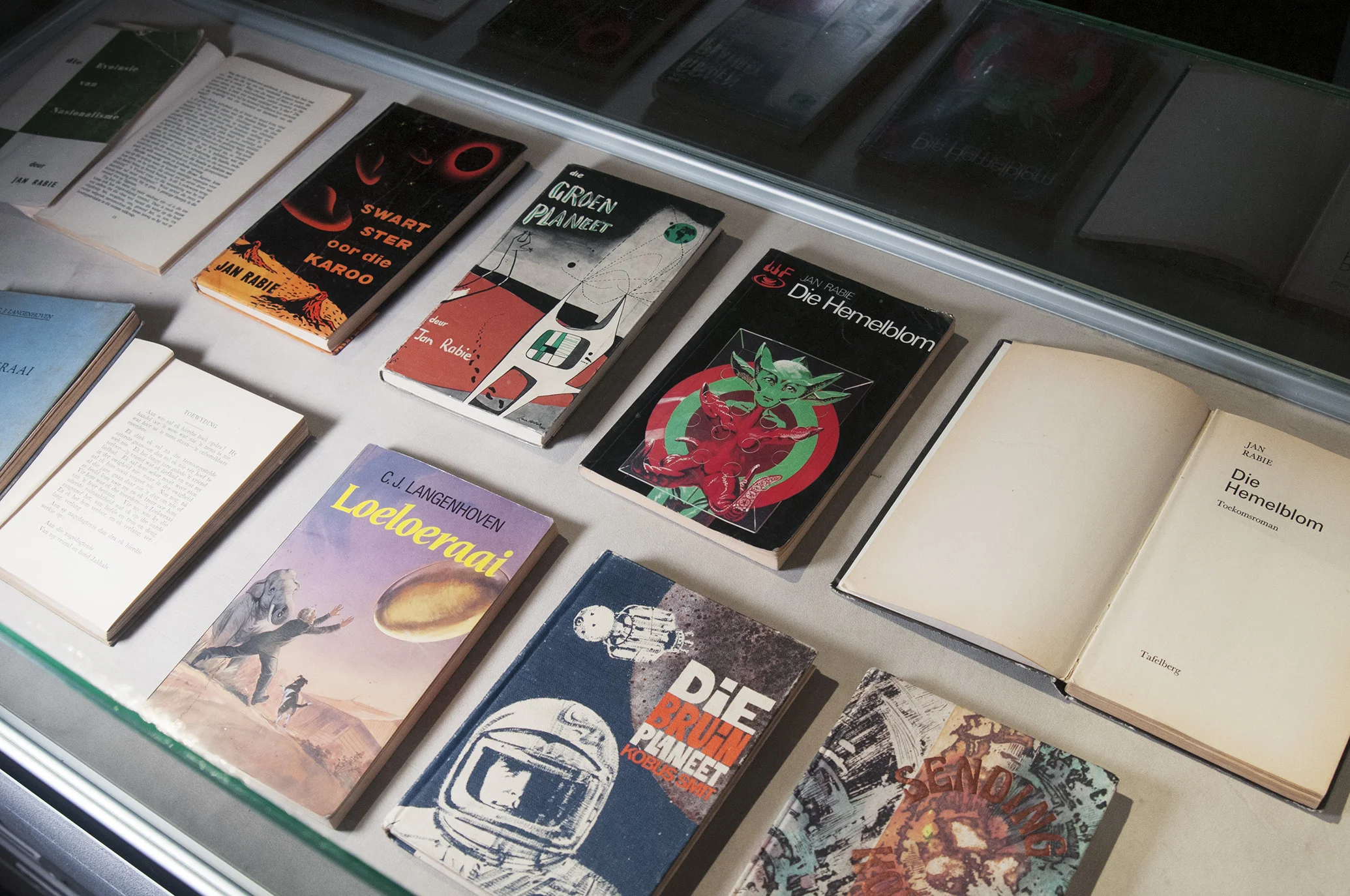
AFRIKAANS SCIENCE FICITON
In this book the main characters undergo an extreme acceleration in a new type of human built space ship. The speed and the effect that it has on them is referred to 'the judgement'. As they slowly start 'remembering' the future they realize that their destination sun and planet is named after themselves.
'To whom shall I dedicate this book? It is about a being who is not human, who is higher than man - an unattainable superior.
I think I will go to the opposite - and then I will not have to look very far. I lost a friend a long time ago - a friend that I loved and who loved me. I will never see him again forever; but forever I will never forget him. Now, after all these years, there is not a day that passes without his image coming before me and I'm grieving about him. To him I was the higher being - a Loeloeraai of a higher existence. To me he was the ultimate perfection I found on earth, of love and faithfulness and virtue. And I lost him, and I miss him dearly. . .
I dedicate this work:
To the memory of
MY FRIEND AND DOG, JAKHALS’
Translated from original Afrikaans by Nic Grobler, Loeloeraai, CJ Langenhoven, 4th Edition 1929, First published 1923.
This is not a sci-fi book, but it was written around the same time of the Swart Ster Oor Die Karoo, and contains a reference to the human relationship with the universe and the coming space age - it places humans in context of space to recommend a position away from nationalism.
'To whom shall I dedicate this book? It is about a being who is not human, who is higher than man - an unattainable superior.
I think I will go to the opposite - and then I will not have to look very far. I lost a friend a long time ago - a friend that I loved and who loved me. I will never see him again forever; but forever I will never forget him. Now, after all these years, there is not a day that passes without his image coming before me and I'm grieving about him. To him I was the higher being - a Loeloeraai of a higher existence. To me he was the ultimate perfection I found on earth, of love and faithfulness and virtue. And I lost him, and I miss him dearly. . .
I dedicate this work:
To the memory of
MY FRIEND AND DOG, JAKHALS’
Translated from original Afrikaans by Nic Grobler, Loeloeraai, CJ Langenhoven, 4th Edition 1929, First published 1923.
Video inspired by the dedication of the 1923 Sci-fi novel, Loeloeraai by CJ Langenhoven.
'Die Hemelblom' (The Heavenly Flower) an Afrikaans sci-fi novel by Jan Rabie from 1971. The 'hemelblom' was sent to the earth by a concerned galactic council to ensure the survival of life on earth in the face of a new world war. The plant was specifically grown to remove the poisonous elements introduced by humans - feeding on pollution it would rapidly cover the earth and wipe out most of humankind but leave a new earth covered with fresh fertile soil.
'Only in the morning, when the daylight crossed over the highland rocks and fynbos, they saw how strange and otherworldly the 'hemelblom' was. The seeds that fell the previous afternoon shot up incredibly fast, each on a lump of roots that didn't enter the ground, but just gripped the ground from above. In one single night each plant became fully grown and was spreading seeds so that new plants would shoot up. In one night the 'hemelblomme' multiplied a hundredfold. For now it was just strange. Only later it would become frightening.'
- Translated from original Afrikaans, Hemelblom, Jan Rabie, first published 1971.
'To whom shall I dedicate this book? It is about a being who is not human, who is higher than man - an unattainable superior.
I think I will go to the opposite - and then I will not have to look very far. I lost a friend a long time ago - a friend that I loved and who loved me. I will never see him again forever; but forever I will never forget him. Now, after all these years, there is not a day that passes without his image coming before me and I'm grieving about him. To him I was the higher being - a Loeloeraai of a higher existence. To me he was the ultimate perfection I found on earth, of love and faithfulness and virtue. And I lost him, and I miss him dearly. . .
I dedicate this work:
To the memory of
MY FRIEND AND DOG, JAKHALS’
From the dedication of Loeloeraai, CJ Langenhoven, 4th Edition 1929, First published 1923. Translated from original Afrikaans by Nic Grobler.
Photograph inspired by Loeloeraai, CJ Langenhoven. Loeloeraai is a visitor from Venus, who spends about two weeks with a family in Oudtshoorn. They end up going on a small trip to the moon before Loeloeraai returns to Venus.
Loeloeraai written in 1923 is a novel about a visitor from Venus, he spends most of his time with a family in Oudtshoorn.
'Loer' means to peek. 'Raai' means to guess.
The book is dedicated to the writers dog Jakhals.
In the book he describes his feeling in the presence of the alien as one that he might guess how a dog feels in the presence of a human.
'We are leaving a memory - an inheritance through the SKA. We are staying positive because a change is coming into the land - so that many people can see. We heard about changes in Sutherland, and now it is happening here as well. Many are negative but they perhaps do not know what is really happening. For our children this will help them, to go into a direction to study, at the University. They spoke about this at the meeting, going in this direction for the youth. For the future I'd love for the children to learn, and not struggle with work, to get a bursary and to study further.'